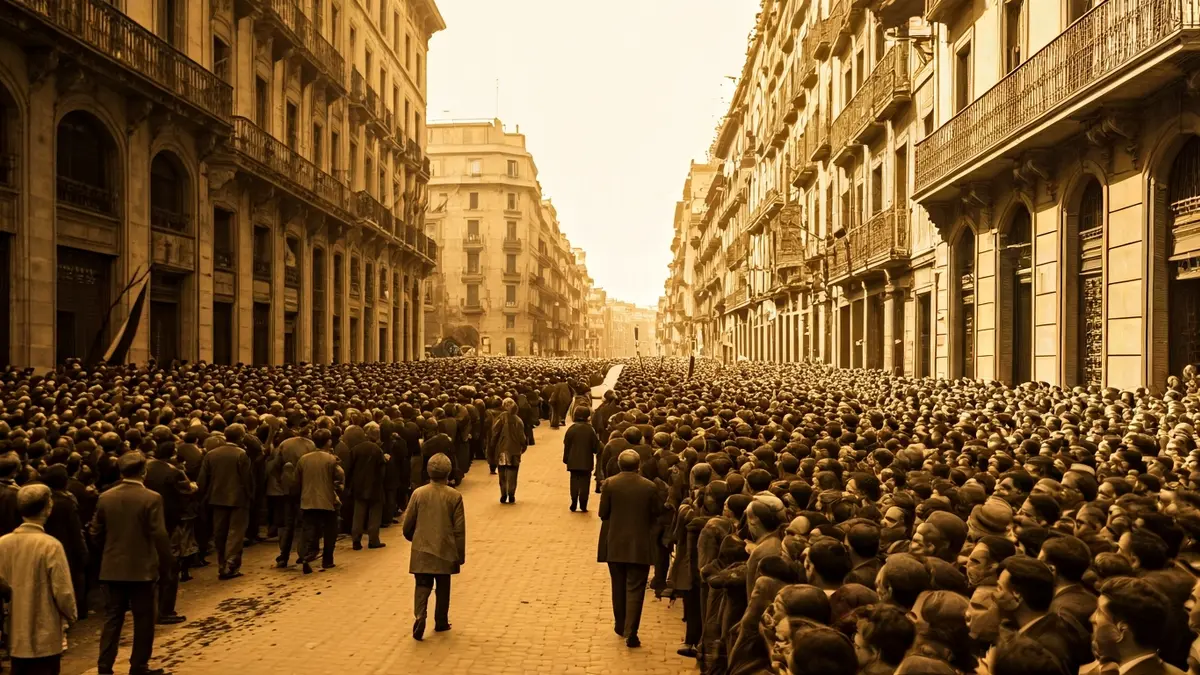
April 14, 1931, marked the beginning of a period of profound transformation in Spain with the proclamation of the Second Republic. This change of regime not only generated great hope but also spurred a series of social and political reforms aimed at modernizing the country and aligning it with the European avant-garde. Between 1931 and 1933, fundamental rights such as women's suffrage, divorce law, a significant military reform led by Azaña, and a commitment to state secularism were introduced.
These milestones were enshrined in the Constitution approved on December 9, 1931. One of its most notable articles, Article 6, established a revolutionary declaration of intent for its time: "Spain renounces war as an instrument of national policy".
“"This article declares that Spain abides by the universal norms of international law."
Deputy Clara Campoamor, a key figure in advocating for women's voting rights, argued on September 1, 1931, that Article 6 was a fundamental piece that placed Spain at the forefront of international law. This article incorporated for the first time in a constitution the Paris Pact renouncing war and adherence to the principles of the League of Nations, going beyond constitutions like Weimar's or Mexico's of 1917.
During the constitutional debate, voices such as Luis Jiménez de Asúa, president of the Constitutional Commission, emphasized the international and pacifist nature of Article 6. Campoamor, with great passion, defended that the president of the Republic could only declare war in cases of "just war" and after exhausting all pacifist procedures, with the aim of avoiding unnecessary conflicts.
However, this pacifist vision was not universally accepted. From conservative and right-wing sectors, Article 6 was perceived as a weakness. The priest and deputy Molina Nieto expressed on September 27, 1931, his concern about a "frightful contradiction" between the renunciation of war and the secular nature of the Constitution, which he considered an aggression against Catholics. Similarly, the Carlist deputy Lamamié de Clairac accused the left of wanting to disarm the Civil Guard and arm the people, seeing in the article a strategy to leave the State unprotected.
Unfortunately, the hope for peace embodied in Article 6 was short-lived. Five years after its approval, in 1936, the political climate drastically deteriorated. One month before the coup d'état, on June 12, José Calvo Sotelo, leader of Renovación Española, delivered a premonitory speech. Finally, on July 18, the coup d'état led by Francisco Franco and other military officers shattered the Constitution, starting precisely with Article 6, and plunged the country into a civil war that would mark the next four decades.