Barcelona attracts millions of visitors annually, drawn by its history and streets that blend tradition and modernity. The city, established as a global tourist destination, showcases a legacy spanning 4,000 years since the Neolithic period, evident in its urban planning and heritage.
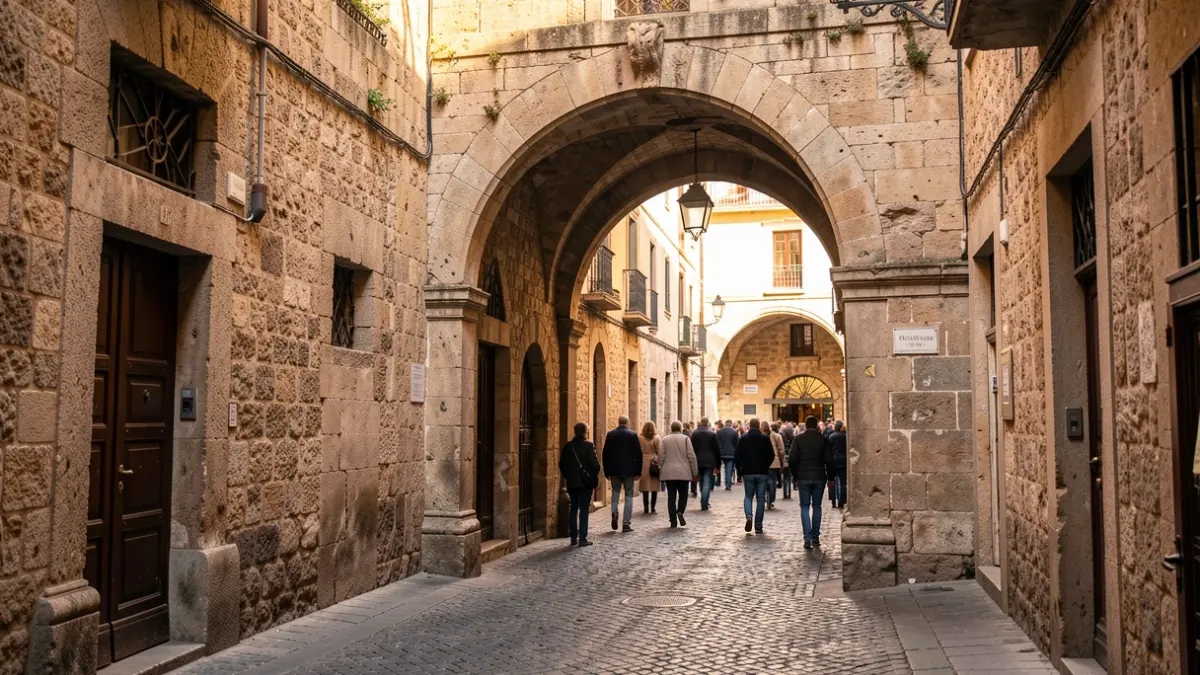
The oldest nucleus is found in the Gothic Quarter, within the Ciutat Vella district. This area originated from Roman Barcino, founded in the 1st century BC. Traces of the wall, columns from the Temple of Augustus, and the original street layout are still visible.
Upon this Roman foundation, the medieval city was built, creating a labyrinth of narrow alleys, squares, and historic buildings. Many streets, such as Carrer del Bisbe, retain their medieval names, reflecting the residence of the Bishop of Barcelona.
The Cathedral of Santa Eulalia, also known as Barcelona Cathedral, is a key landmark. Constructed between the 13th and 15th centuries, it stands on a former Romanesque cathedral, which itself was built over a Visigothic church and a Paleochristian basilica, whose remains are housed in the History Museum.
The Plaça del Rei, dominated by the Palau Reial Major, was the center of medieval power and the residence of Catalan counts. Its Saló del Tinell, featuring semicircular arches, now serves as an exhibition space. Other sites like Plaça Sant Felip Neri and Plaça Sant Jaume encapsulate centuries of political, religious, and social history.
In addition to the Gothic Quarter, other areas of Ciutat Vella, such as El Born and El Raval, which grew from the Middle Ages onwards, complete the city's original historic core.