A research team from BIST, including the BIST Community Centre ICFO and ICN2, has identified a synergy between chromium and ruthenium that significantly enhances the durability of catalysts used in water electrolysis. This finding, published in Nature Materials, opens new avenues for more efficient and sustainable green hydrogen production.
Ruthenium, commonly used in single-atom catalysts to speed up water electrolysis, tends to over-oxidize and dissolve during operation. Researchers explored the protective role of chromium, drawing inspiration from its function in stainless steel. They designed a synthesis method to bring ruthenium and chromium atoms into close proximity within an oxide scaffold.
Using advanced electron microscopy and synchrotron spectroscopy, they observed that chromium acts as a "buffer" against ruthenium's over-oxidation, preserving its catalytic activity. The atoms began to behave cooperatively, forming local units that respond together during catalysis, thereby improving catalyst durability.
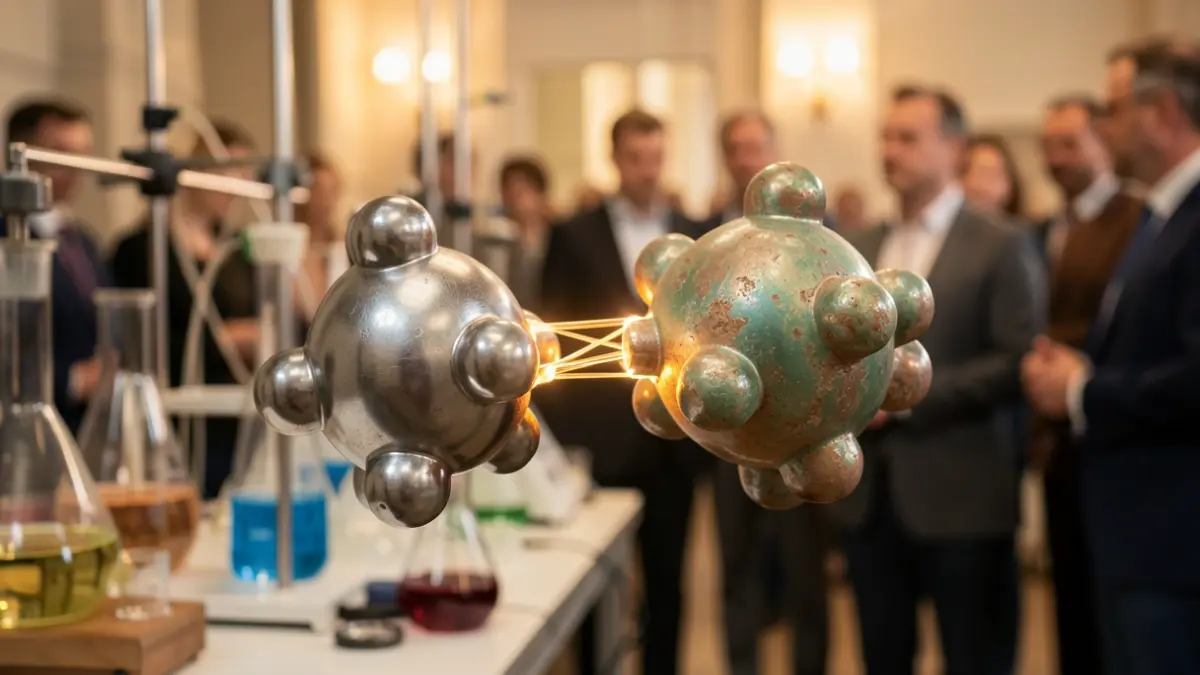
"It was like seeing Cupid's arrow striking two different atomic elements," comments Tengyu Chen, one of the first co-authors. "These coupled atomic units work in tandem to control how the catalyst evolves during operation, improving its durability. It was meant to be!," adds Lu Xia, also a first co-author.
The next step will be to achieve more precise control over the formation of these atomic units to generalize the principle and translate it into practical technology. "More efficient and durable catalysts could make renewable hydrogen production less dependent on scarce precious metals and more affordable," explains Professor Pelayo García de Arquer, lead researcher of the study. Such strategies are key to the long-term goal of producing clean hydrogen as fuel.