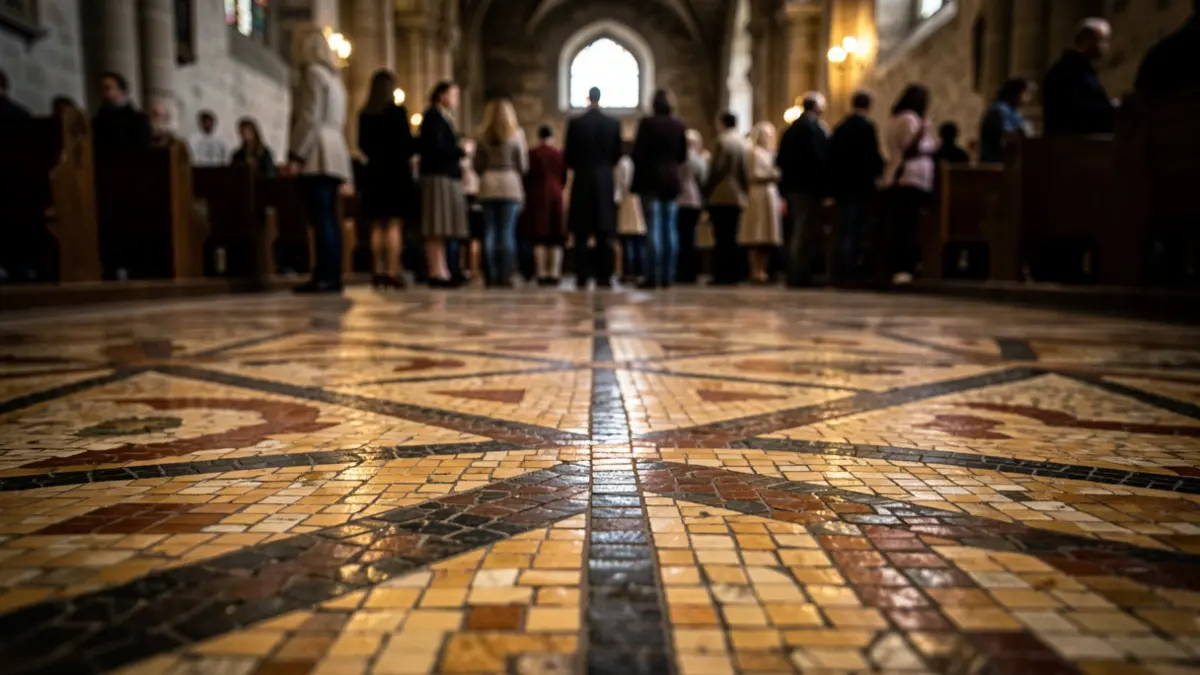
The legacy of Antoni Gaudí extends throughout Barcelona, and one of his lesser-known vestiges is found in the heart of Sant Andreu. It is a mosaic on the floor of the main nave of the Sant Pacià parish, designed by the renowned architect during his student years. The building, designed by Sant Andreu architect Joan Torras i Guardiola, Gaudí's former teacher, was completed in 1881.
In the recent District Plenary Council, held on May 13th, a proposal by Junts was approved, with the support of all groups except for the abstention of the PSC. It urges the Generalitat to declare the mosaic a Site of National Cultural Interest. Xavier de la Cruz, Junts councilor for the district, emphasized that the Year of Gaudí and the 2026 World Capital of Architecture are opportunities to promote a comprehensive rehabilitation plan.
The proposal also requests the District to promote the necessary actions for the "conservation, restoration, and effective protection" of the mosaic. De la Cruz warned that its state of conservation is "worrying" due to decades of use and humidity problems, calling for coordination between the property owner and the involved agents.
Municipal councilor David Paredes indicated that the declaration as a cultural heritage site is the responsibility of the Department of Culture of the Generalitat and the Office of the Chief Architect. He reported that a petition is already registered with the Generalitat, and therefore the District will monitor the existing initiative rather than launching a new one.
De la Cruz highlighted the history of the temple, which includes the Tragic Week of 1909, when it was burned and looted, and the Civil War, during which it was confiscated and converted into the popular canteen "Menjadors Durruti." These events make the "survival of a heritage that is part of the identity of Sant Andreu and Barcelona" even more valuable.
Gaudí's mosaics were last restored in 1988 by the mosaicist Lluís Bru. "Almost forty years have passed, and the intensive and continuous use as a Parish has damaged the most exposed parts of the mosaic," noted the Junts councilor, highlighting the need for a new intervention.