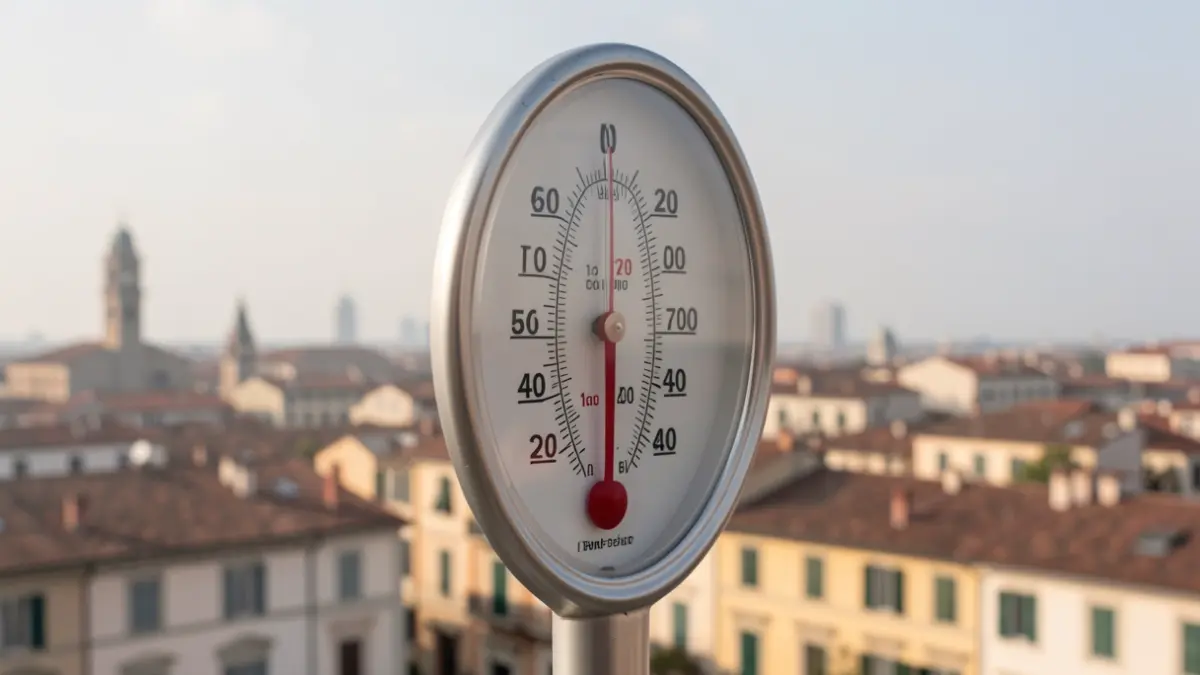
The heatwave that recently affected Western and Northern Europe is beginning to subside, offering a few days of respite in Catalonia and Barcelona as well. Temperatures will approach normality during the middle of the week, but this pause will be brief, as medium-term forecasts point to a new thermal surge before the weekend, with intense heat expected in the first days of July.
The warm air mass responsible for last week's high temperatures will move towards Eastern Europe and the Eastern Mediterranean starting Monday. Meanwhile, a cooler air mass of Atlantic origin will influence the European Atlantic facade, the Cantabrian region, and, more mildly, Catalonia. This change at altitude will favor a drop in surface temperatures.
Between Wednesday and Thursday, Barcelona will record highs close to the usual values for the season, around 30 degrees Celsius. A slight decrease of two to three degrees is expected compared to the higher readings at the beginning of the week. Barcelona's meteogram shows a brief thermal normalization coinciding with the start of July, before temperatures rise again.
Although there is still uncertainty about the intensity of the next heatwave, all indications suggest that the coming week will be marked by above-average temperatures in Catalonia and Europe, with less precipitation than usual. The Atlantic anticyclone, centered between the United Kingdom and Northern Spain during the upcoming weekend, will favor a notable temperature increase in Catalonia from Friday, July 3rd, especially in the central and western parts of the Iberian Peninsula. The Lleida region could reach 40 degrees on Sunday.
Subsequently, from July 6th onwards, the anticyclone will move eastward, affecting the Iberian Peninsula, Western and Northern Europe, and the British Isles. Heat could once again be significant across the continent. This situation might resemble previous episodes, with heat generated 'in situ' by subsidence, a phenomenon of air warming associated with the descending movements of anticyclones. When an anticyclone remains stationary during the period of maximum insolation, heat becomes trapped and accumulates due to a lack of ventilation.