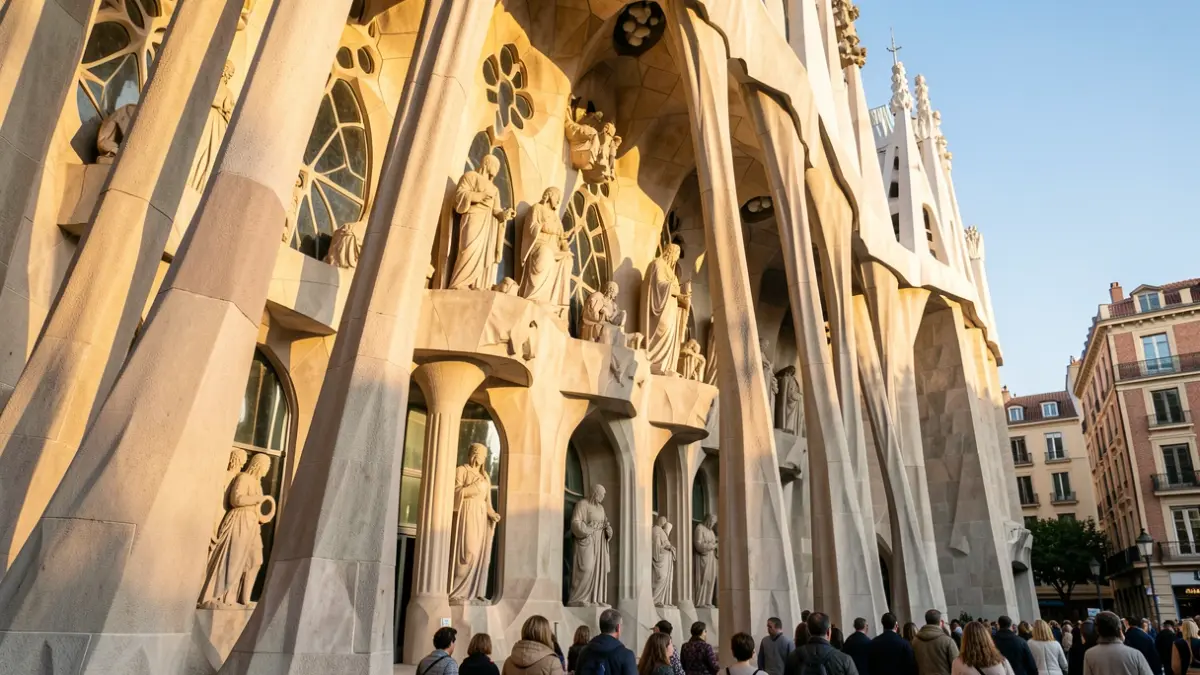
The decision by León XIV to visit the Torre de Jesús of the Sagrada Familia, coinciding with the centenary of Antoni Gaudí, was leveraged by the Spanish government and the Episcopal Conference to promote the basilica and its creator as elements of 'Marca España' (Brand Spain). The aim was to prevent the international projection of these universal icons from being seen as a projection of Catalonia, seeking to assimilate Catalan talent and heritage under a Hispanic label.
The presence of the Bourbon monarch was considered key to monopolizing media attention, relegating Catalan authorities to a secondary role and presenting Catalonia as just another region within the State. Official events were planned primarily in Spanish, with minimal concessions to Catalan, to convey an image of unity and demobilization of the independence movement.
Despite these plans, Catalan media pressure forced a rectification, increasing the presence of Catalan. However, the events were marked by heavy police control, with a deployment of 7,000 officers, including the Spanish police and the Guardia Civil. This figure was considerably higher than previous visits, such as that of Benedict XVI, and involved a budget of 15 million euros, far exceeding the 700,000 euros from that time.
This police operation is part of a strategy to criminalize independence movements, comparing it to the classification of "terrorist" for council members and movements like the CDR and Tsunami Democràtic. The confiscation of 'esteladas' (Catalan flags), even from the sheet music of the Sagrada Familia choir, culminated in the expulsion and confinement of children's choirs, causing fear and tears among the children and their subsequent prohibition from participating in the closing ceremony.
The contradictory versions provided by the Spanish police, the Spanish Episcopal Conference, the Spanish government, and the Government Delegation in Catalonia regarding the expulsion of the singers highlight, according to the author, a hate crime. This action is described as "barbarity" and "fascism," reflecting a common practice of the Spanish state towards Catalan dissent.
The legal firm Acció Cassandra has filed a lawsuit, considering the incident a "coercive, arbitrary, and extraordinarily serious act" against Catalan citizens. The lawsuit argues that the expulsion and detention of the children's choirs could fall under crimes of illegal detention, abuse of authority, and ideological hatred, and warns that normalizing such events represents a qualitative leap in symbolic repression.
The article argues that in a democratic regime, prior censorship and mind control are unacceptable. It asserts that the singers' desire to perform the Catalan anthem, as the host country, was not a terrorist act but a legitimate expression. Submission and the denial of one's identity only strengthen oppression, and freedom can only be achieved through disobedience and rebellion.