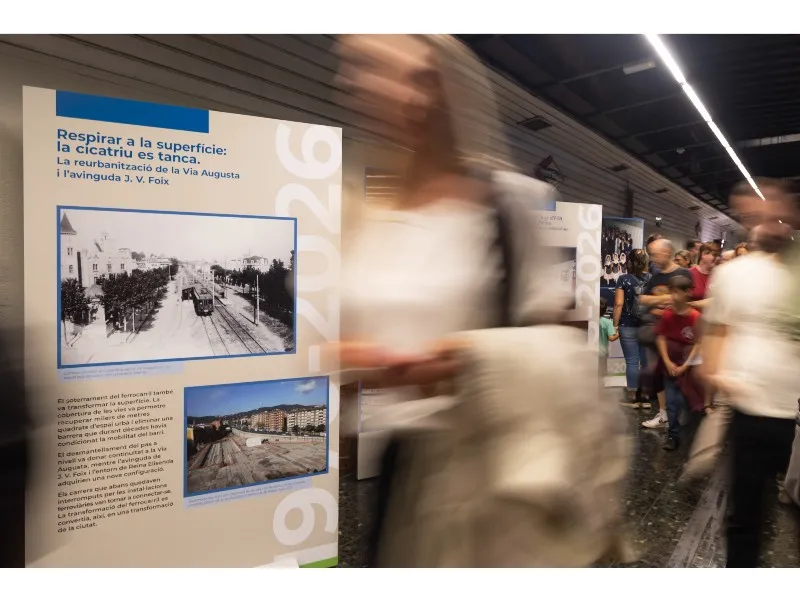
The company celebrated the milestone with the inauguration of a permanent exhibition on the platform of the FGC Reina Elisenda station. The exhibition reviews the transformation brought about by the burial of the tracks and the creation of the new branch for Ferrocarrils de Sarrià a Barcelona (FSB), as well as its importance for the subsequent creation of Ferrocarrils de la Generalitat de Catalunya (FGC) three years later. The exhibition will be accessible during the station's opening hours.
During the event, Carles Casas Esplugas, Director of Strategic Planning and ASG at Ferrocarrils, highlighted that the project aimed "to connect Sarrià with the city of Barcelona" and improved residents' quality of life. Casas emphasized that these changes were "essential" in shaping FGC as it is known today.
In parallel, FGC has published the historical booklet "1976-2026. 50 Years of the Sarrià Station Undergrounding and the New Reina Elisenda Branch", also presented today.
The undergrounding work, carried out "in the open" without interrupting train services, transformed mobility in the upper area of Barcelona and unified the neighborhood. The construction included 500 new meters of tunnel towards Reina Elisenda. In 1979, the underground stations of Sarrià and Reina Elisenda, inherited from FSB, became the backbone of the Metro del Vallès (current lines L6 and L12) after the company faced economic crisis and was transferred to the Generalitat de Catalunya.
Last year, Sarrià station recorded 4.2 million journeys, making it the third busiest on the Barcelona-Vallès line, while Reina Elisenda handled over 451,000.
The commemoration also featured FGC's giant figures: el Trenot and la Catenària. La Catenària, representing a train driver, was unveiled last year and symbolizes the commitment to gender equality. El Trenot, created in 2004, depicts a station agent with iconic accessories. Both giants are managed by the Colla Gegantera de Sarrià.