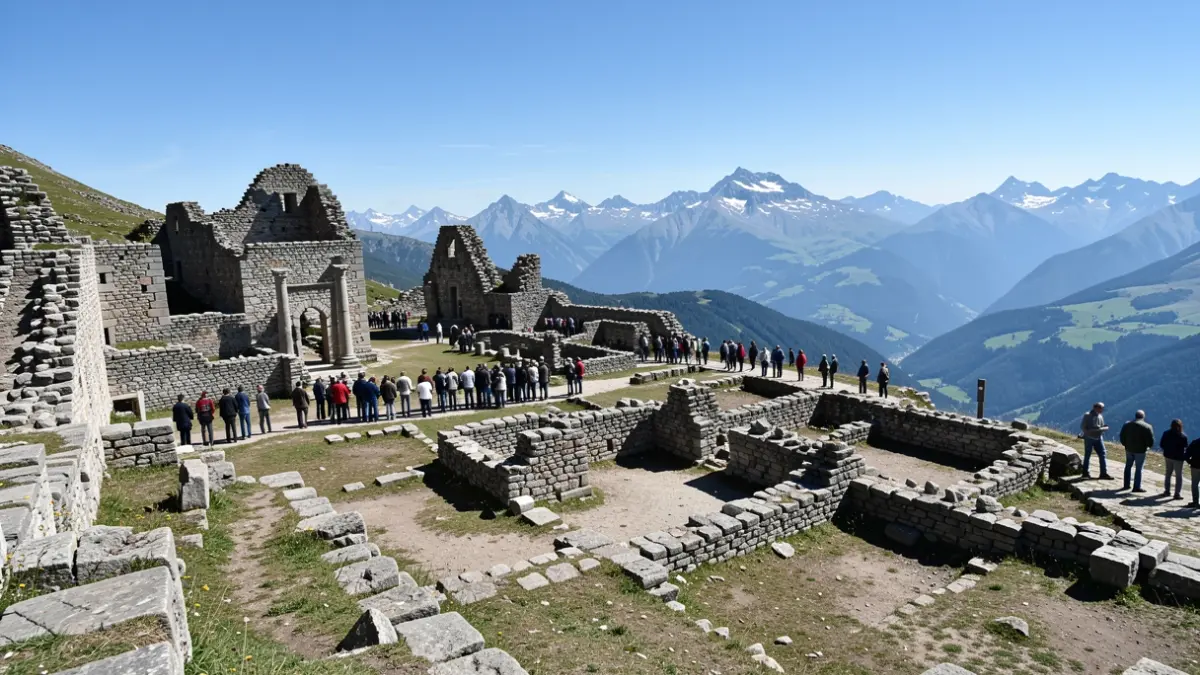
One of the proposals, already in development, will connect the Roman site of Coll de Molleres, located at 2,500 meters, with other heritage elements near the Malniu lake. The second route, still under study, will focus on the Duran valley, where a possible Bronze Age pastoral settlement has been documented.
The first route will follow part of the itinerary towards Puigpedrós, linking the sites of Coll de Molleres I (Roman, the highest in Catalonia and the Mediterranean basin) and Coll de Molleres II (Neolithic, fourth-third millennium BC), with a third point of interest at Estany Sec. This summer, path improvement works have already been carried out, and an observation platform has been built to enhance the visitor experience and ensure conservation.
The second proposal, in the Duran valley, still in the study phase, aims to confirm the dating of the Duran II site (2,300 meters). The circuit would begin in the pla de Campllong area and ascend the valley to the Engorgs area. The ICAC plans minimalist signage with interpretation points about the landscape and the historical relationship between human activity and the high mountain zone.
Recently, the Research Group in Landscape Archaeology (GIAP-ICAC) completed the second excavation campaign at Duran II. A team of nine archaeologists worked for ten days to expand soundings, recover pottery fragments, and analyze charcoal samples to study the use of forest resources. Documented structures include large stone enclosures.
According to Josep Maria Palet, director of the ICAC, the campaign was positive, recovering prehistoric pottery with cord decorations. He highlights the site's interpretive potential as a rarely represented pastoral settlement, which could fill a historiographical gap regarding high mountain occupation during the Bronze Age, about 4,000 years ago.
The area's sites help understand the origin of transhumance in the Pyrenees and the historical transformation of high mountain areas by activities such as pastoralism or agriculture. Marta Flórez, head of transfer at the ICAC, emphasizes the importance of converting scientific knowledge into cultural resources for sustainable development.
The actions in the Duran valley were designed with the Meranges Town Council and coordinated with local stakeholders such as the Malniu refuge and the Kilian Jornet Foundation, within the Cultur-Monts project (Interreg SUDOE).
Following the campaign, Duran II has been covered with a geotextile tarp for its conservation and protection until the next intervention.