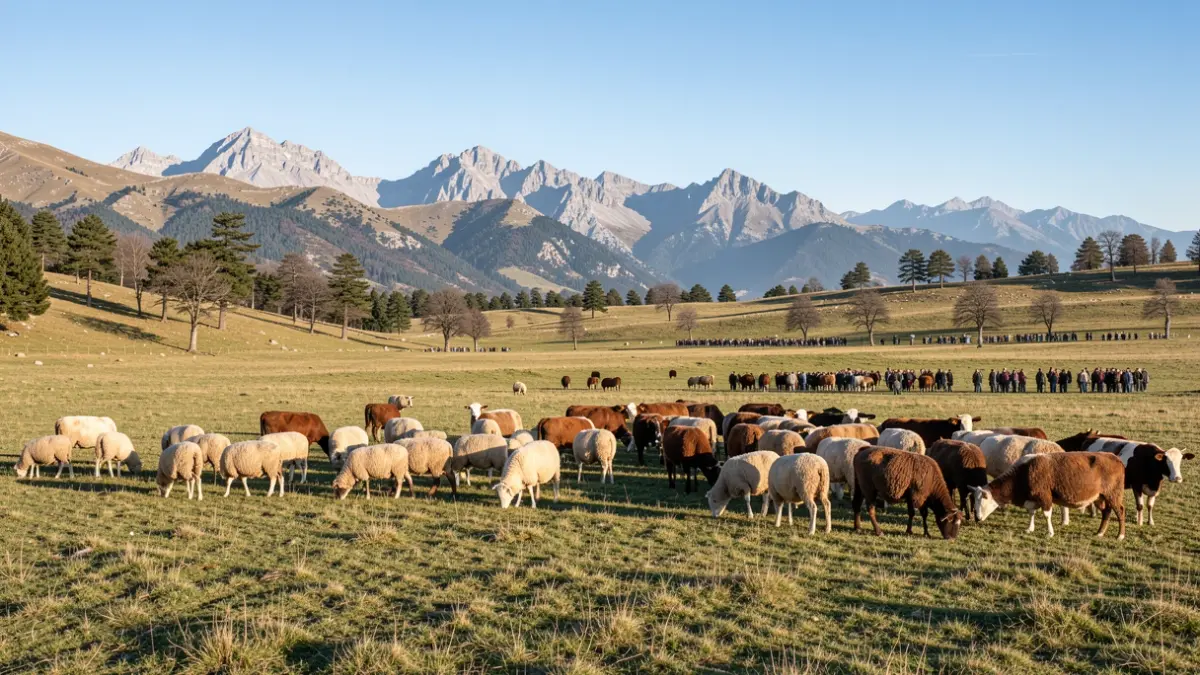
Livestock farmers from various Pyrenean regions, including Pallars, Cerdanya, Ripollès, Berguedà, and Solsonès, have moved their animals to the Llessui mountain to take advantage of its optimal conditions: a large area with little forest cover, abundant water, and quality pastures. Despite a decrease in extensive livestock farmers, this practice sees fewer professionals managing a larger number of animals, forcing them to seek areas outside their home municipalities.
Most animals arrive in Llessui by truck, although a small portion still maintains the tradition of traveling on foot. Once unloaded near the village, farmers accompany them up the mountain, where they will stay throughout the summer months. Confidence in favorable weather during July and August is crucial for ensuring grass growth and allowing the livestock to remain until early October.
Albert Baqueró is responsible for overseeing the livestock for the next four months. He will live in the shepherd's hut, located at an altitude of approximately 2,000 meters. Baqueró, who has been doing this job for eight years, monitors the animals' health, ensures they stay within the designated perimeter, manages the pastures, and resolves any incidents that may arise, reporting them to the owners.
Farmers like Albert Sobirana, from Montellà (Cerdanya), highlight the difficulty of finding suitable grazing areas in their municipalities due to forest expansion. Sobirana positively assesses the Llessui mountain for being an open space, treeless, and with access to water.
The transfer of animals is mainly carried out by trucks, as explained by Jorge Vartolomei, one of the transporters covering the 100-kilometer route to Pallars. This journey can take about four hours due to the winding mountain roads, where caution is essential for the animals' well-being.
The role of a permanent shepherd is highly valued, as noted by farmer Marta Pons, from Berga. The presence of a shepherd in Llessui facilitates the owners' task, as on other mountains, they have to make frequent trips to supervise the animals.
Albert Baqueró is also one of the farmers who still undertakes the transhumance on foot, considering it a cultural heritage and a tradition that should not be lost. He estimates that only 5% of farmers opt for this traditional method.
In addition to cows and horses, the Llessui mountain hosts over 4,000 sheep from a dozen farmers, cared for by an assigned shepherd. In total, the mountain can accommodate around 6,000 heads of livestock during the summer months.