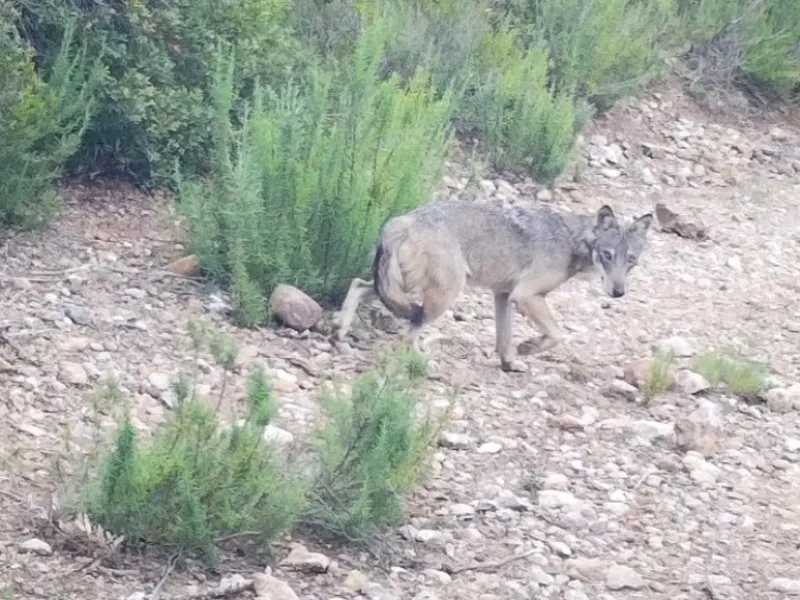
The Department of Interior and Public Security of the Generalitat de Catalunya, through the Rural Agents Corps, has confirmed the birth of five new wolf cubs (Canis lupus) in Catalonia. These cubs belong to the same pair that in 2025 had the first three cubs born in Catalan territory in over a hundred years. Currently, the pack consists of the two adults, 2 subadults born last year, and the 5 new cubs this year. One of last year's young wolves is no longer detected with the group, while the other two, a male and a female, are identified and remain with the pack.
The Department of Territory, Housing and Ecological Transition is finalizing the Species Recovery Plan, as the wolf is defined as an endangered species. The document will be developed with all interested stakeholders within the framework of the Wolf Table and is expected to be submitted for public information at the beginning of next year.
The presence of wolves in Catalan territory has been continuously confirmed since 2000, with individuals originating from France and part of the natural expansion of the Italian population. Most data is concentrated in the northern half of Catalonia, particularly in the Alt Empordà and Alta Garrotxa regions, where this single registered pack has established itself. The wolf's return to the region is part of a natural process following its disappearance over a century ago due to human persecution, and is favored by the increase in wild ungulate populations and legal protection of the species.
The Rural Agents Corps is responsible for monitoring the large carnivore population and is working to consolidate a Large Carnivore Monitoring Unit with 40 specialized agents. In parallel, the Special Animal Capture Group (GECA) is being trained for the capture and handling of problematic individuals, and the expansion of the Canine Special Group (GEK9) is planned.
The Department of Agriculture, Livestock, Fisheries and Food will strengthen support for the livestock sector in response to the presence of wolves. Its organizational decree will be modified to directly assume the management of compensation for damages caused by large carnivores, and enclosure systems and protection measures adapted to each farm will be analyzed to reduce the risk of attacks.
Through the Wolf Table, a dialogue body involving departments, agricultural organizations, and environmental entities, efforts are underway to advance in species management and conflict prevention. Until the new decree is implemented, the Department of Territory continues to promote a damage prevention support program, including the provision of materials, promotion of livestock guardian dogs, and financial support for self-protection. The compensation system for livestock killed by wolf attacks has been improved, including loss of profit and veterinary services, and 47 cases have been processed in the last five years, with 35 positive.