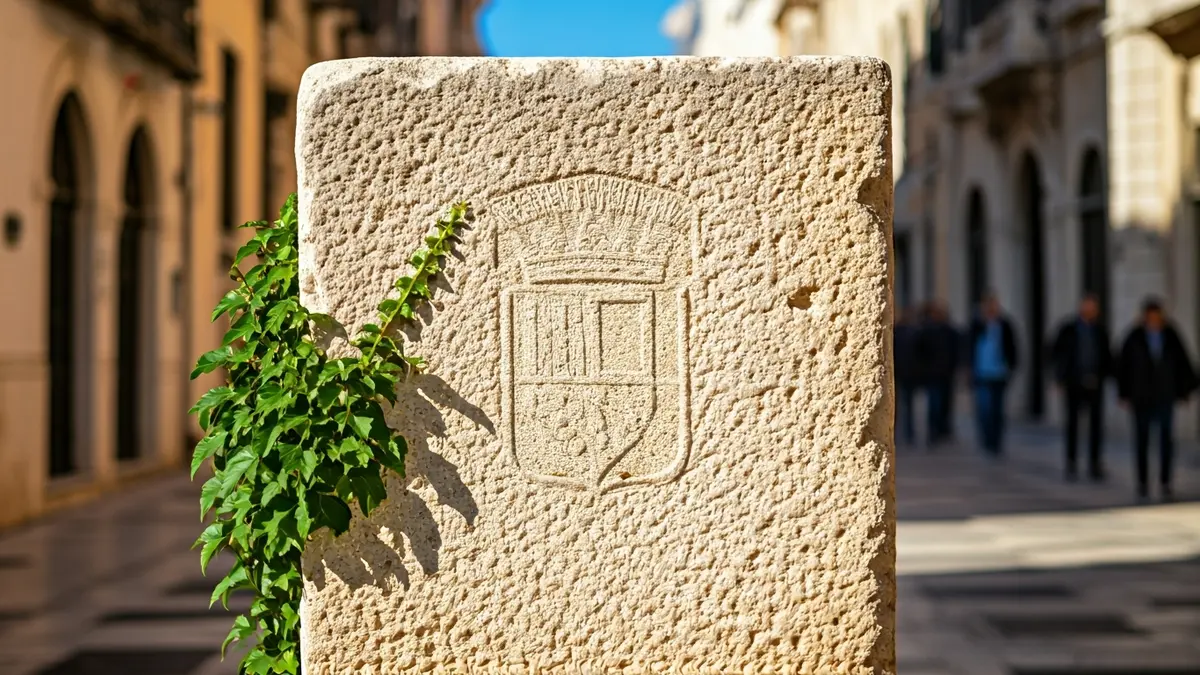
Walking along Girona's Carrer de la Força, in the Placeta de l'Institut Vell, one can observe a unique stone bearing the city's coat of arms. This milestone marks a historical border, invisible to the naked eye, yet fundamental to understanding the Girona market for several centuries.
On February 13, 1445, Queen Maria of Castile, wife of Alfonso V, granted Girona the privilege of the half-league. This regulation prohibited the sale of products such as wine, milk, or meat within half a league of the city walls. The objective was economic: vendors within the city had to pay taxes at the entrance gates, and the measure sought to prevent them from setting up outside to evade these fees. Those who violated the rule faced the demolition of their establishment and a fine of 1000 gold florins.
The half-league was not just a matter of distance, but also a powerful tool for controlling people's daily lives.
The 'half-league' was not measured in modern units, but by travel time. A league was equivalent to the distance a person or horse could cover in an hour, so half a league represented about 3.35 km, the distance walkable in half an hour. Thus, an imaginary circle was created around Girona, with a radius of about 3.35 km from the city gates, where the sale of food and drinks was prohibited. This border, more than physical, was a social and economic barrier.
The monopoly persisted during the 16th and 17th centuries. After the War of the Spanish Succession, in the 18th century, neighboring towns began to circumvent it. Faced with this situation, on October 9, 1726, the Intendencia General de Catalunya, at the request of the Girona City Council, confirmed the city's rights and promulgated the 'New Establishment'. This decree led to the placement of fourteen stone milestones on the royal roads leading to the city, bearing Girona's coat of arms and the inscription 'Per la mitja llegua'. Despite resistance from nearby municipalities, the monopoly was finally abolished in the 19th century, and the milestones lost their original function.
Currently, one of these milestones can be seen in the Placeta de l'Institut Vell, in front of the Girona Municipal Archive. When it was installed, it was outside the city walls, but today it is part of the urban core, demonstrating the city's growth beyond its historical limits.
For those interested in delving deeper into this history, the Girona Municipal Archive preserves the original document of the privilege, copies in the Llibre Vermell, and records of the negotiations. This information can also be consulted on the archive's website. Additionally, it is recommended to listen to episode 568 of the podcast En guàrdia! about Queen Maria of Castile and her role as ruler of the Crown of Aragon.
This event, which took place in the late Middle Ages and during the Modern Age, offers a perspective on life and trade in medieval markets and fairs in towns such as Calonge, Hostalric, or Vic. The InfoK video about the medieval market of Vic and issues 2 and 84 of the magazine Petit Sàpiens, which deal with the Middle Ages and the Modern Age, respectively, are additional resources to delve into the topic.
In the current context, where responsible production and consumption are crucial, as established by Sustainable Development Goal number 12, the half-league milestone reminds us that the debate over urban market control is not new. Looking to the past can inspire models of more sustainable and balanced cities for the future.