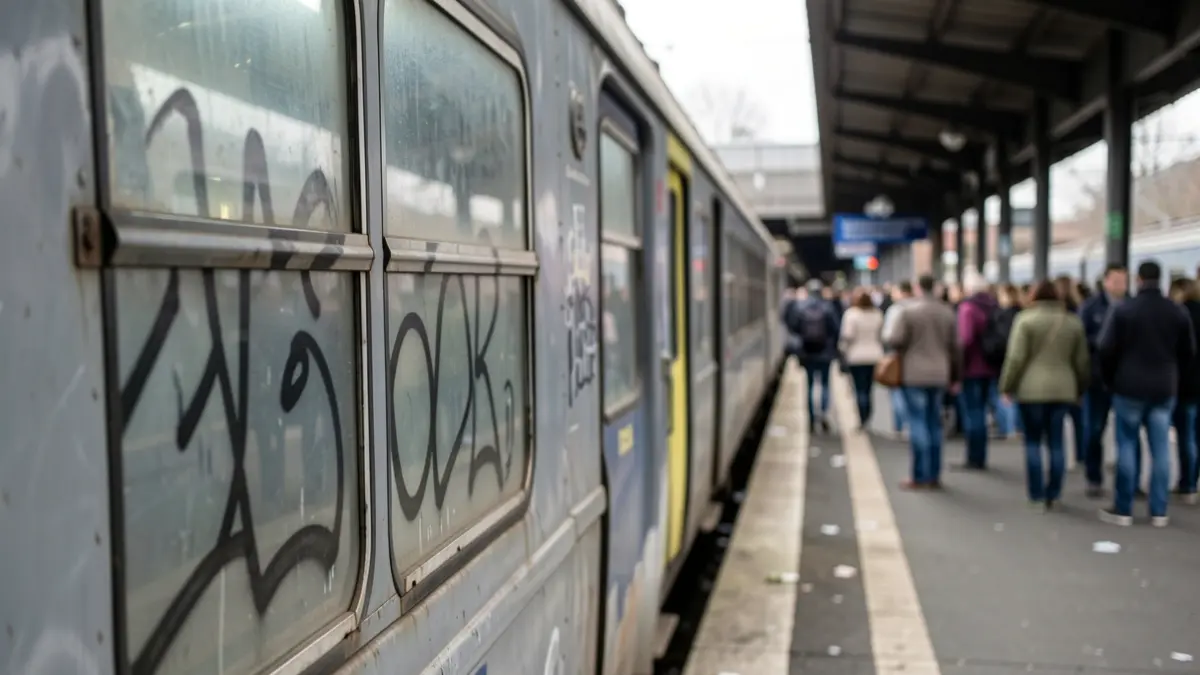
The railway infrastructure, located in the Baix Penedès region, has seen a significant number of vandalism acts, ranking only behind Montcada-Bifurcació (31 incidents), Barcelona's Estació de França (23), and tied with Cornellà and Granollers Centre (22 each).
This phenomenon led Renfe to register 970 graffiti complaints in Catalonia during 2025. The graffiti required the cleaning of 55,100 square meters of train surfaces, costing the company 7.4 million euros.
Beyond the economic impact, graffiti also directly affects services. On average, two trains are rendered inoperable daily due to these acts, particularly when the graffiti obstructs drivers' visibility. This necessitates the deployment of reserve trains or modifications to planned compositions, affecting approximately 1.4 million passengers the previous year due to delays or schedule changes.
To combat this issue, Renfe has intensified surveillance in sensitive areas like Sant Vicenç de Calders. The company has implemented six dynamic night services and incorporated drones for enhanced monitoring. A canine unit has also been trialed, and new cameras with automatic drone activation capabilities for suspicious movements will be installed.
Furthermore, efforts are underway to expedite graffiti removal. Currently, there are five cleaning points in Catalonia (Ripoll, Sant Andreu, Estació de França, L'Hospitalet de Llobregat, and Vilanova i la Geltrú), with new facilities planned for Reus and Sant Vicenç de Calders. New cleaning products have reduced removal time from nearly an hour to about 15 minutes.
Renfe acknowledges the complexity of the phenomenon, noting that organized groups are often behind these vandalism acts, and highlights that Catalonia concentrates a significant portion of this activity.