The Secretary for Ecological Transition, Jordi Sargatal, and the Director General for Climate Change and Environmental Quality, Sonsoles Letang, presented this Tuesday in Cellers (Castell de Mur, Pallars Jussà) the Action Plan for the preservation and promotion of Montsec's night sky (2026-2030). The roadmap, developed by the Department of Territory, Housing and Ecological Transition in collaboration with the Montsec Observatory (OdM - IEEC) and the Montsec Astronomical Park (PAM - FGC), has incorporated 84% of the 49 proposals from citizens, municipalities, and local entities.
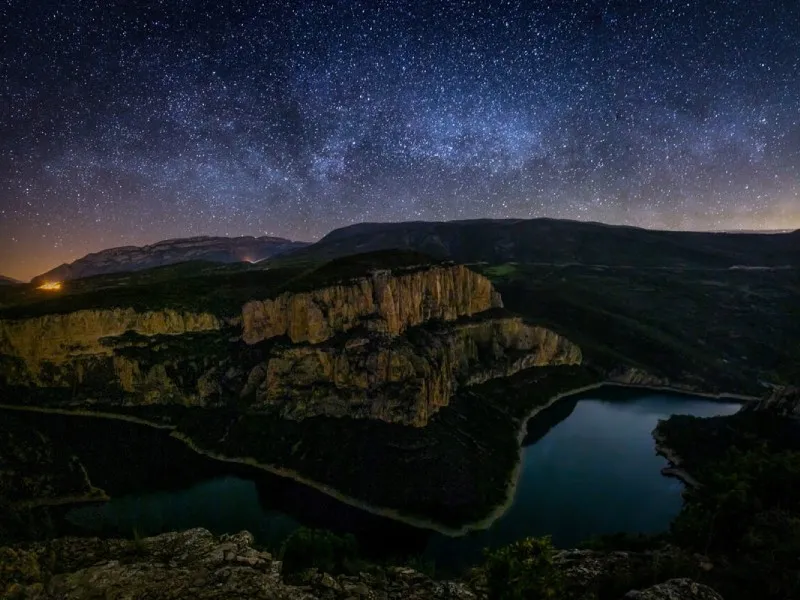
Light protection in the Montsec mountain range, initiated in the 1990s, was consolidated with subsequent laws and expansions that extended the influence zone to over 2,000 km² and twenty municipalities. Given the emergence of new technologies like LED lighting and the need for coordination, a new transversal instrument was essential for the next five years, structured into 5 axes and 16 specific measures.
As a main axis, the Plan foresees the creation of a new coordination and governance monitoring body. Sargatal highlighted the importance of this new structure for channeling actions between administrations, the private sector, and local entities, addressing an essential management need, especially while the formal figure of a Natural Park is being processed.
The plan includes the creation of a Pyrenean dark sky corridor, working to connect Montsec with the Alt Pirineu Natural Park and the Aigüestortes i Estany de Sant Maurici National Park, with cross-border alliances with France and Aragon. Sargatal announced the upcoming incorporation of Senterada and Conca de Dalt into the protected zone, which could form the largest light pollution protected area in Europe. It also aims to identify nearby polluting sources, promote international certifications like the DarkSky Reserve, create a network of astronomical viewpoints, encourage sustainable lighting with orange light, and organize 'Dark Sky Nights', in addition to launching a Citizen Science platform and the educational kit 'Night Explorers'.
Sargatal emphasized the importance of night environment quality for biodiversity, as many animals depend on darkness for their vital functions. The EU's Nature Restoration Law points to the need to restore degraded ecosystems, and currently, only 16% of the protected natural areas in Catalonia enjoy darkness close to natural levels.
Meanwhile, Sonsoles Letang announced a new call for subsidies to improve outdoor lighting in protected area municipalities, with a total budget of 3.6 million euros between 2027 and 2028.
The presentation took place during the 9th International Starlight Astrotourism Meeting in Montsec, an event recognizing the territory's efforts to preserve a key area for sky observation and sustainable astrotourism development. The area hosts key infrastructures such as the Montsec Observatory, with the Joan Oró telescope, and the Montsec Astronomical Park (PAM), visited by over 30,000 people annually.