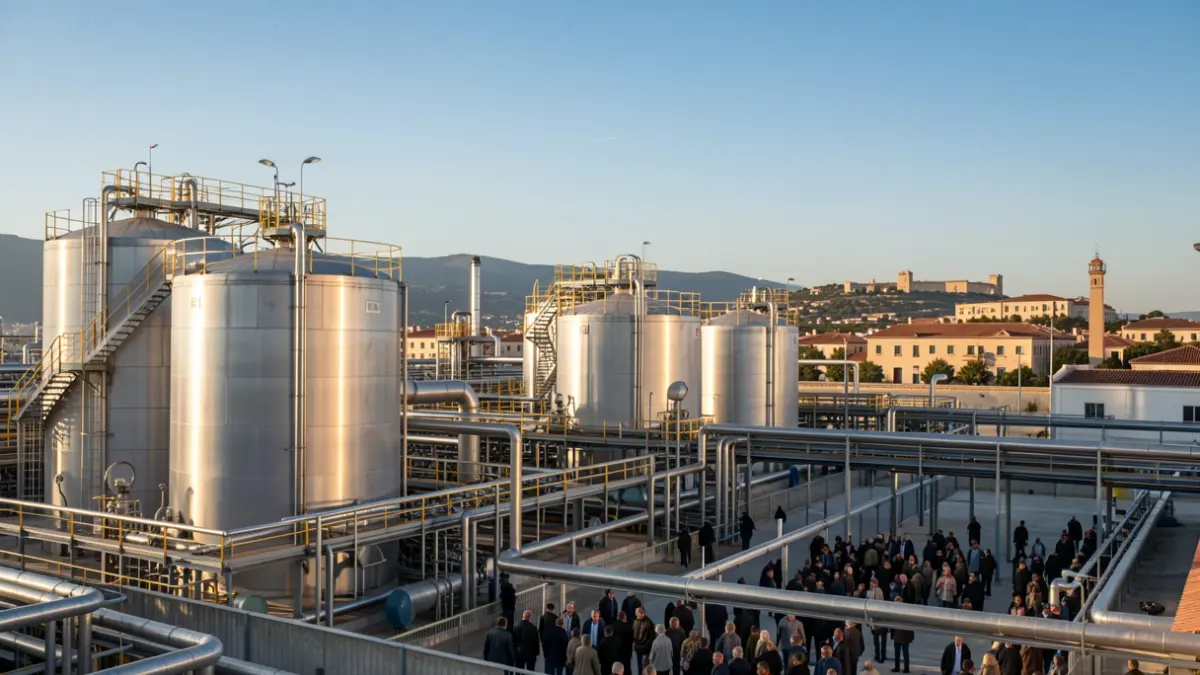
The National Pact for Industry (PNI) has focused on the need to drive the decarbonization of the petrochemical complex in Tarragona. This initiative plans to offer financial support to projects that reduce CO2 emissions and foster sectoral agreements to achieve a more sustainable production model. The Minister of Business, Miquel Sàmper, highlighted during the pact's presentation in Tarragona that the Catalan chemical sector is showing better resilience to the crisis compared to its European counterpart.
The PNI, the result of an agreement between the Government, unions, and employers, also aims to expand and create new industrial parks in the region. Among the planned projects are Catalunya Sud in Tortosa, as well as those in Alió and Vila-rodona, in addition to smaller ones like the one in Bot. These new infrastructures seek to accommodate established companies and attract new ones.
Regarding Terres de l'Ebre, Minister Sàmper emphasized the region's key role in energy production and its industrial fabric focused on agri-food transformation, the furniture industry, and construction materials. He also stressed the importance of having efficient "public services" that facilitate workers' access to their jobs.
The creation of new industrial land is a key component of the PNI, managed by the Institut Català del Sol (Incasòl). The director of Residential Land and Economic Activity at Incasòl, Jordi Salvat, announced that the initial approval of the Urban Planning Master Plan (PDU) for Vila-rodona and Alió is expected this July, encompassing 230 hectares, including a 130-hectare plot, with an estimated investment of 60 million euros.
Concerning the Catalunya Sud industrial park in Tortosa, spanning 360 hectares, the project also anticipates an initial approval, although specific dates have not been provided. Salvat also highlighted the significance of more local projects such as those in Móra d'Ebre and Bot, the latter covering 4.7 hectares and to be financed with funds from the Nuclear Transition.
During the presentation, Minister Sàmper met with representatives of the STR union from the chemical company DOW. Workers expressed their concern over the company's intention to lay off 138 employees, the majority in Tarragona, and requested a tripartite committee to explore alternatives.
The chairman of the DOW Sud works council, David Navarro, stated that "in Tarragona, no one is surplus" and questioned the unilateral nature of the layoff plan. Minister Sàmper assured the Government's support for the affected workers and reaffirmed the commitment to reindustrialization and the creation of quality employment, emphasizing the strategic role of the chemical sector for Catalonia.