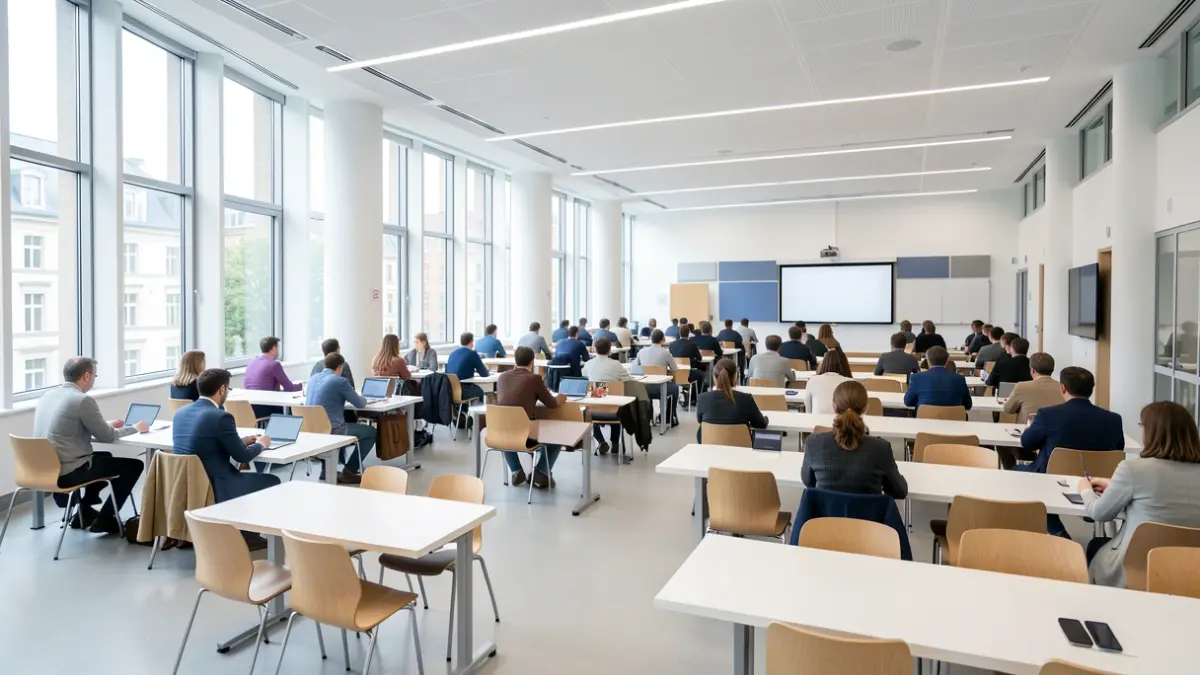
A multidisciplinary research project from the URV, led by Jordi Duch, Mercè Gisbert Cervera, and Roger Miralles i Jori, highlights that many university classrooms still adhere to a one-way teaching model, featuring fixed furniture and inflexible technology. This rigidity hinders active methodologies, group work, and teaching experimentation.
The researchers argue that university space is not merely a container for learning; its configuration—including layout, furniture, lighting, acoustics, and technology—significantly influences pedagogical activities. An adaptable environment, according to Jordi Duch, a researcher from the Department of Computer Engineering and Mathematics, facilitates dialogue, collaboration, and student participation.
However, the study emphasizes that architecture alone does not determine educational outcomes. Learning depends on the interaction between people, methodologies, space, and technology. An architecturally innovative classroom may be ineffective without clear pedagogical objectives, just as a traditional space can be enhanced through flexible digital tools, notes Mercè Gisbert from the Department of Pedagogy.
The proposal links space characteristics to different learning levels. Activities such as recalling or understanding information can be conducted in static spaces with conventional technologies. Conversely, more complex processes like analyzing, evaluating, or creating benefit from open, reconfigurable environments with adaptable tools. The model is based on potentiality (the environment's capacity to foster critical thinking and creativity) and permeability (the connection between physical and digital spaces, formal and informal learning, and the university and its social environment).
Flexibility can be achieved by modifying the space, the technology, or both. Even with budgetary constraints, universities can progressively transform their environments using movable furniture, interactive digital whiteboards, or real-time interaction platforms.
The research also criticizes that many campuses have been designed primarily from the perspective of faculty and management, leading to a prevalence of lecture-style classrooms and a scarcity of open, shared spaces. To address this, the authors advocate for participatory design involving students, faculty, administrators, technology specialists, and architects, to better identify the needs of end-users.
The importance of incorporating diversity in abilities, backgrounds, and learning styles is highlighted, emphasizing accessibility and inclusion criteria from the outset, such as ergonomic furniture, adjustable lighting, and supportive technologies. A gender perspective is also proposed to prevent inequalities in space usage.
Regarding technology, the study promotes "invisible integration," where systems are user-friendly, compatible, and do not add extra burden. Generative artificial intelligence, for instance, can personalize learning paths and provide immediate feedback if used accessibly and coherently.
Transforming classrooms also requires organizational and cultural change, shifting from a management focus on room allocation and utilization to one that seeks the most suitable configuration for each activity. The authors suggest starting with small-scale interventions, such as rearranging furniture or utilizing common areas, placing pedagogy and people's needs at the center of the design.