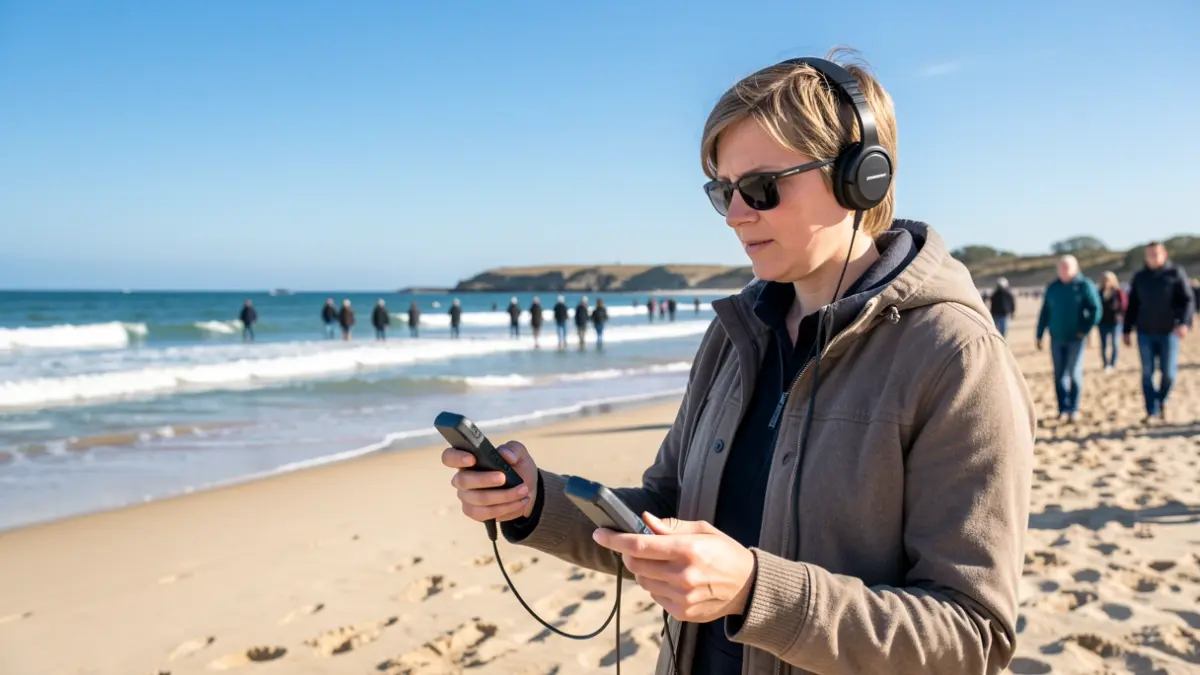
The Arrabassada beach in Tarragona has launched an innovative acoustic system designed to enhance the autonomy of blind individuals when enjoying a swim. This service will allow users to enter and exit the sea safely thanks to a system of buoys anchored to the sand that emit sound information.
Before entering the water, visually impaired individuals will receive instructions and a wristband with three buttons at the Red Cross facilities. This device will enable them to communicate and orient themselves acoustically during their swim, ensuring their independence without the need for an escort.
The service, which is free of charge and does not require prior reservation, will be available daily from 10 AM to 8 PM until September 15th. In addition to Tarragona, the municipality of Cunit has also adopted this system.
The system utilizes buoys that emit an acoustic signal, helping swimmers to locate themselves and determine their distance from the shore. A member of the lifeguard team supervises the user from the sand to ensure safety, allowing up to five visually impaired individuals to swim simultaneously. Agustí Sánchez, manager of SeaLand, the company behind the project, highlighted the system's significant orientation capabilities.
The Councillor for Environment, Public Space, and Youth of Tarragona, Guillermo García de Castro, emphasized that this initiative enhances the beach's accessibility and grants autonomy to people with functional diversity, complementing other measures such as access platforms and amphibious chairs.
Rocío Calcerrada, a rehabilitation technician from the ONCE, explained that the organization will train users on the meaning of each acoustic signal. She stressed that the system is crucial for those who come alone or accompanied, as it promotes autonomy, a key objective of accessibility.
Currently, this system is implemented on only two Catalan beaches: Arrabassada in Tarragona and Cunit beach. Nationally, it has already been installed on beaches in Fuengirola, Ibiza, Granada, and Valencia.