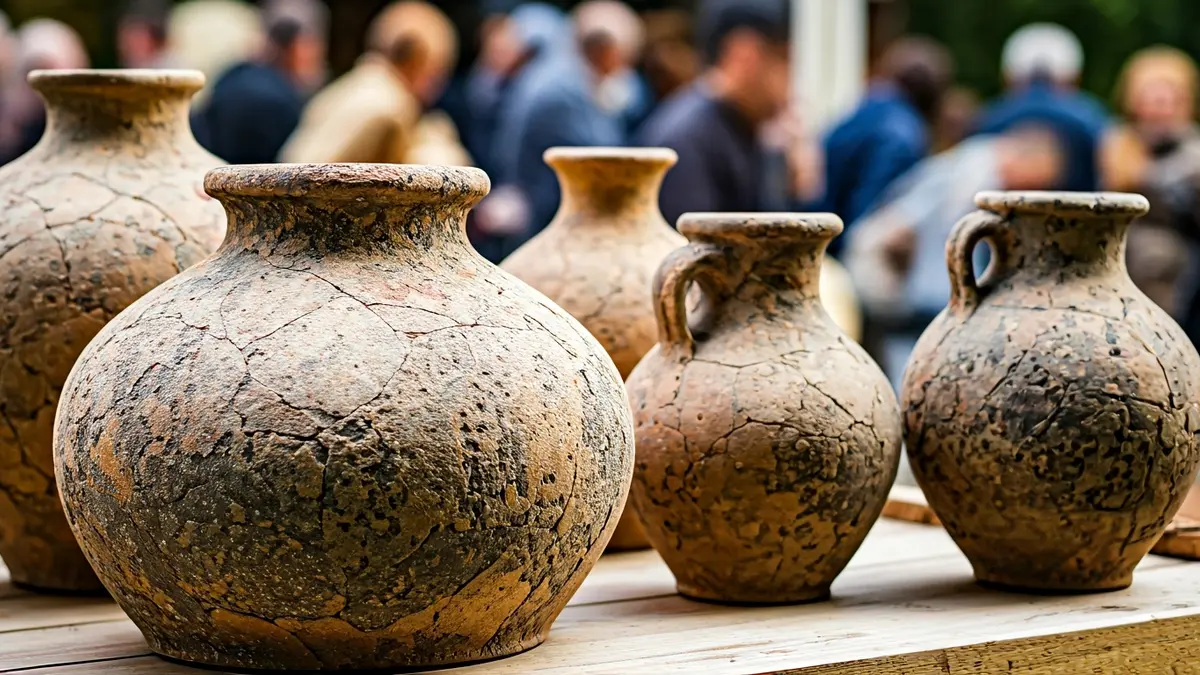
This research project, named Reproducing Iberian Pottery, culminated with the opening of an experimental kiln that recreates the firing techniques of the Iberian era. Inside the kiln, 333 pieces, including jars and amphorae, crafted by local ceramists, were fired.
The installation, a replica of a kiln excavated in the Penedès area, stands out for its large dimensions—over two meters in diameter—and its two-chamber structure separated by a grate. The roof, made of clay, straw, and ceramic fragments, faithfully reproduces ancient firing methods.
“"The objective was to achieve optimal firing using traditional techniques."
The firing, which took place last November, lasted over 14 hours, reaching a planned temperature of about 980 degrees. The outcome has been very positive: the pieces exhibited excellent quality, demonstrating the success of the experiment. These works will now be available for sale to museums, collectors, and the general public as commemorative items of the project.
In parallel, the Estinclells site continues its annual excavation campaigns, which last between two and three months. Recently, a campaign focused on removing the asphalt from the old road was completed to uncover the Roman site, located at the base of the hill and next to the LV-2021 road. Although the area is now fully visible, it has been confirmed that the site extends under the new road layout, and the team hopes to excavate this new area during the summer.
Since last November, the Archaeological Complex has offered a self-guided tour system. Users obtain a numerical code at the Verdú Tourist Office, which grants access to the site for a 30-minute autonomous exploration with digital audio guides activated via QR codes. These improvements, which include the consolidation of original vestiges from the 3rd century BC, have been carried out since 2021 with an investment of over 403,000 euros in aid from the Generalitat.