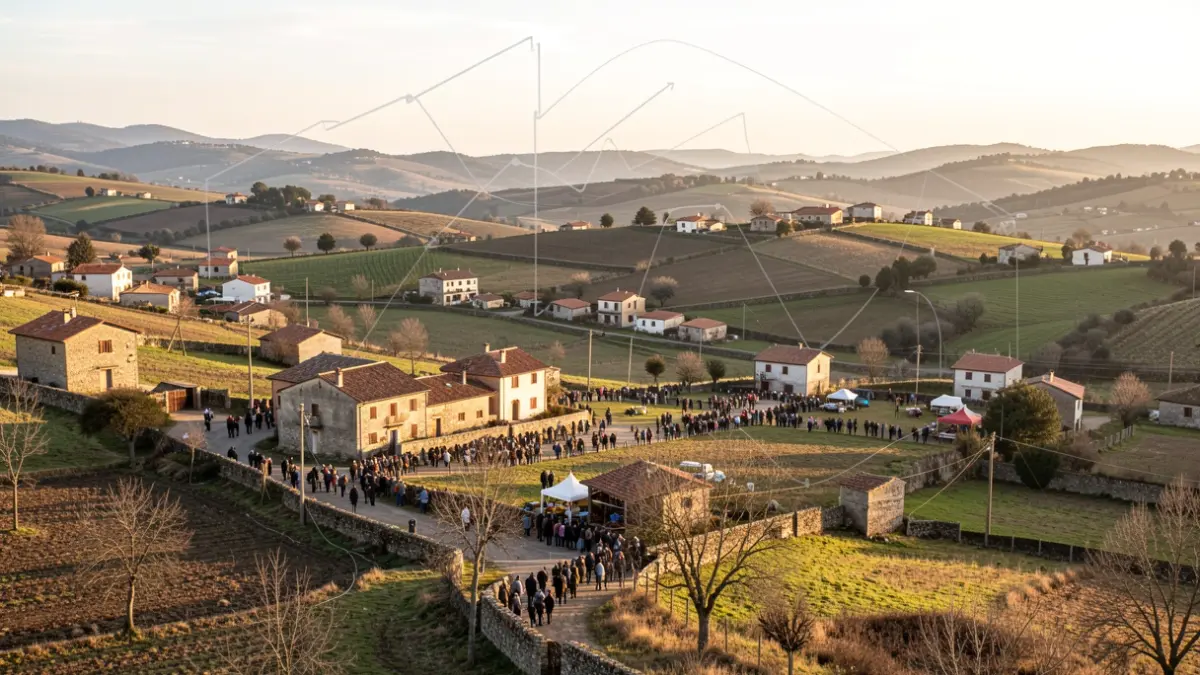
The event will take place on Saturday, May 16, at Verdú Castle, starting at 6 PM. The aim is to guide citizens and local councils on how to participate in the public exhibition period of the plan.
According to the initially approved document, the Vall del Corb could host wind power capacity of up to 1,038.2 MW, equivalent to between 160 and 200 wind turbines up to 200 meters high. Additionally, 736.5 MW of photovoltaic power is foreseen, which would occupy 3.7% of the valley, mainly in productive agricultural land. This capacity would exceed 5,420% of the area's electricity consumption, making it one of the main energy generation centers in Catalonia.
“"This allocation consolidates an unbalanced model for the deployment of renewables, with a very high concentration in rural and sparsely populated areas."
Watt del Corb believes that PLATER does not establish clear limits on the size of installations, which could favor the implementation of large power plants and a model based on macro-projects far from consumption centers. The entity emphasizes that, despite being a necessary instrument, the plan does not incorporate sufficient mechanisms to ensure a fair distribution of impacts and benefits among territories, nor does it define a progressive deployment that avoids the anticipated concentration of projects.
The workshop will feature the participation of Sergi Saladié, a geographer and professor at the Universitat Rovira i Virgili, an expert in energy planning, and lawyer Meritxell Cotrina, from the Environmental Defense Fund and professor at the Universitat de Barcelona, who will offer guidance on how to submit effective objections.
The entity argues that the energy transition is essential, but its implementation must be fair and balanced, without reproducing existing territorial imbalances. Therefore, it encourages citizens, entities, and local councils to inform themselves and actively participate in the public exhibition process.