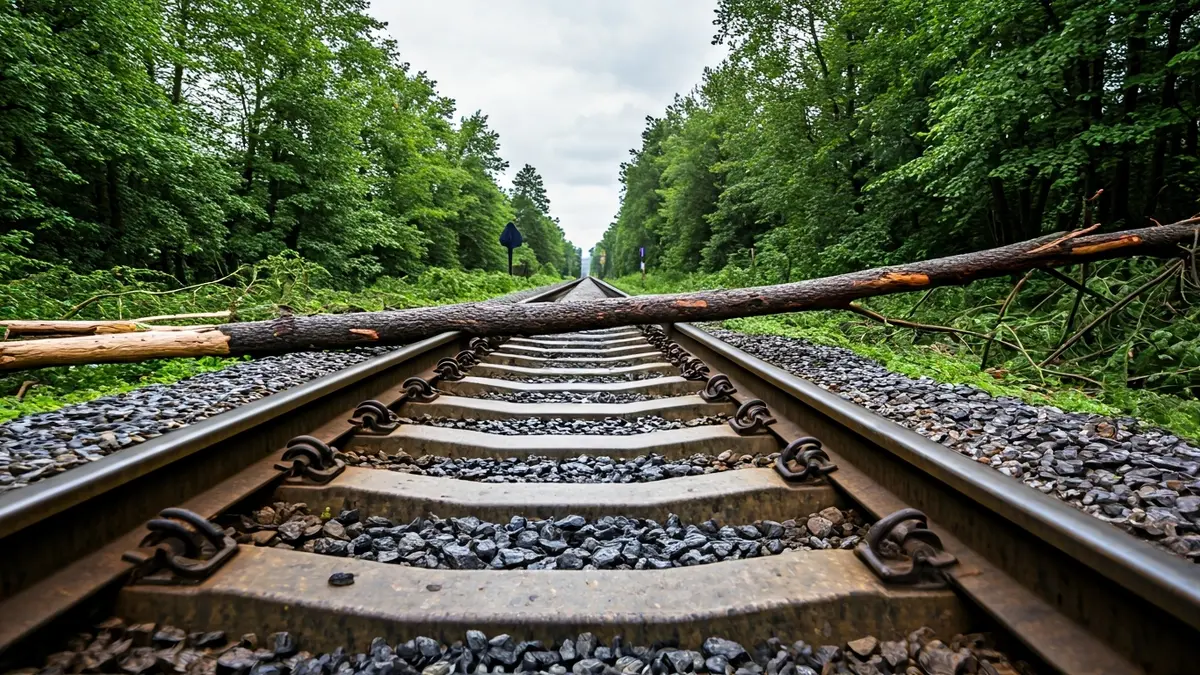
Fallen trees on the tracks were a major cause of incidents during severe weather, highlighting the fragility of Catalonia's railway infrastructure against meteorological adversities. Of these, 8,380 trees were removed as part of the regular vegetation control plan, while an additional 5,300 were felled under a specific emergency plan for the storms. The most affected area was the stretch between Maçanet and Portbou.
In addition to trees, the storms caused the collapse of retaining walls and embankments, as well as landslides. These incidents forced Adif to implement hundreds of temporary speed restrictions (LTVs) at various points across the network, the consequences of which are still being felt today. Currently, the managing entity continues to work on the repair and maintenance of 130 embankments throughout the Rodalies network, with approximately 360 operators deployed.
The situation changes daily, and many of these new restrictions have been in place for a short time, due to specific and already resolved incidents.
At the beginning of March, there were still 216 speed restrictions in force across the 1,200 kilometers of Catalan tracks. Although Adif sources clarified that these are "temporary" restrictions and that the entity is working "at a good pace" to lift them, government sources confirmed that 78 of these restrictions were removed last month. However, new ones were also added, with none of the involved entities (Adif, Renfe, or the Generalitat) willing to detail the exact number, citing the constantly changing situation.
The forecast is for the week to begin with 179 active speed restrictions, a figure significantly higher than the 95 LTVs the network typically experiences under normal operating conditions. These restrictions are a standard safety measure in Adif's contingency plans, activated in response to environmental alerts.
For its part, Renfe has implemented operational changes to minimize the impact of LTVs on schedules, improving rotations and making strategic reservations. The operator assures that service has recovered to 94% compared to the pre-storm period, with 846 daily services on a weekday. Normalcy has been restored on the R4 (Sant Vicenç de Calders - Terrassa Nord section) and the R1, while the R2 has improved with new timetables. The Minister of Transport, Óscar Puente, expressed confidence that temporary speed restrictions will be resolved by June.
Concurrently, works on the Rubí tunnel, crucial for both passengers and freight, and the Garraf tunnel, where structures damaged by marine corrosion are being secured, are progressing according to schedule. The most critical section of Rubí is expected to reopen in early May, and works in Garraf are anticipated to conclude within the planned three-month timeframe.