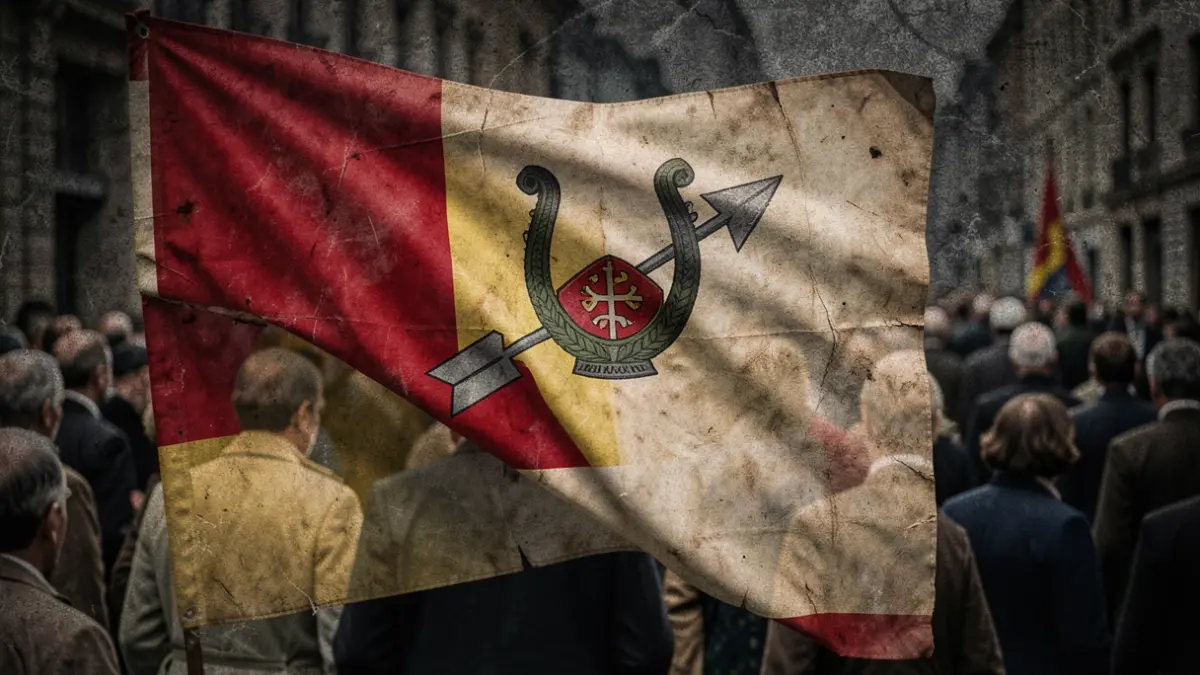
The Women's Section of the Spanish Falange, founded in June 1934 in Madrid by students led by Pilar Primo de Rivera, saw its influence grow during the Civil War and consolidated as an organization for female indoctrination and control with the decree of December 27, 1939, establishing the Servicio Social, a type of military service for women.
In Sabadell, the origins of the fascist party date back to contacts between Luys Santa Marina, head of the Falange in Barcelona, and Magdalena Coret Planas, who would become the main local leader. After the uprising of July 18, 1936, Santa Marina, imprisoned in Sabadell, recruited Coret to organize a Francoist espionage network from prison. Coret was appointed head of the female and male Falange for the city and its region.
By the end of the war, activities intensified with the collection of funds and information for the Socorro Blanco, which operated as a Francoist fifth column. The Republican Military Intelligence Service (SIM) arrested 95 Sabadell residents accused of working for the Socorro Blanco, including Magda Coret. The subsequent trial resulted in 56 death sentences, which were not carried out due to the war's end.
The first headquarters of the Women's Section in Sabadell was located in confiscated premises on La Rambla. Research by Àngels Ferràndiz suggests difficulties in establishing the actual number of members, but an estimated 1,448 girls were in Vallès in October 1940. The organization enrolled girls from age 7 through the Frente de Juventudes.
The annual initiation ceremony, held on October 15, marked the transition of young women into the Women's Section, with solemn acts and speeches by Pilar Primo de Rivera. The leadership core in Sabadell was headed by Magda Coret, who maintained relations with Falangist hierarchies and received visits from Pilar Primo de Rivera.
The Women's Section controlled departments such as Dissemination, Press and Propaganda, and Physical Education, later expanding responsibilities in Culture, Labor, and Youth. At lower levels, figures like Montserrat Buxeda Brujas and Maria Forrellad Solà stood out.
The Servicio Social, mandatory for women aged 17 to 35 for six months, had a significant social impact. It was carried out in charitable and social institutions in Sabadell. The certificate was a requirement for employment or obtaining official documents, with limited exemptions.
The Auxilio Social, created at the beginning of the Civil War, provided humanitarian and food aid to the population. After the war, it played a crucial role in Sabadell and was eventually integrated as a department of the Women's Section. Its fundraising activities, such as 'postulaciones,' served as a form of social control.
Under the leadership of Magda Coret, the Women's Section collaborated with Nazi and Fascist leaders. Sabadell hosted delegations from the Hitler Youth and the Nazi party, involving exchanges of the Führer's portraits and the awarding of honor badges to Coret and Montserrat Sampere. Mayor Josep Maria Marcet received various delegations.
The Y de plata, the highest decoration of the Women's Section, was awarded to Magda Coret in October 1943. The celebration of the Anniversary of Liberation on January 27 was a significant event, particularly in 1942 with Franco's visit to Sabadell.
Following the Nazi defeat, the Francoist dictatorship attempted to erase overt fascist symbolism. Magda Coret withdrew from local political life to marry and move to Madrid. The Women's Section gradually lost power and influence until its dissolution in 1977, facing growing opposition to the patriarchal ideology that confined women to the home.