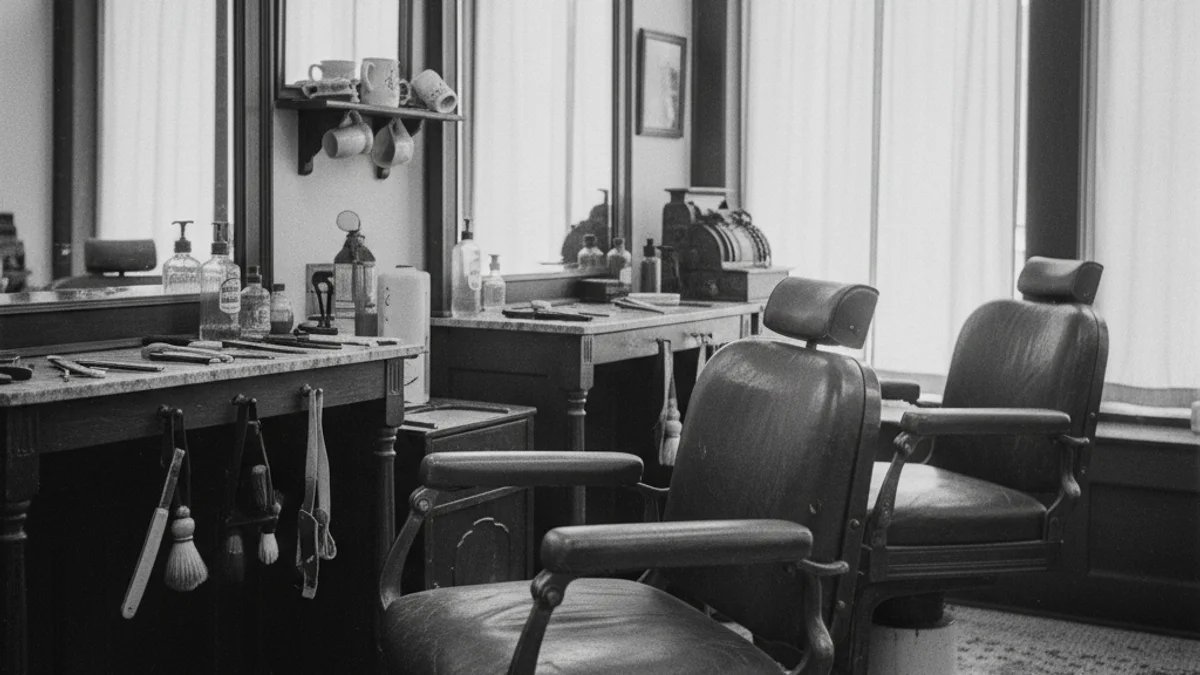
The barber profession in Sabadell, documented by Marian Burguès in his memoirs Sabadell del meu record, was of great social importance in the mid-19th century. Barbers not only cut hair and shaved but also performed paramedical functions, such as applying leeches, bleeding, or giving assistance, a practice that required a title.
“"All the gentlemen in the town wore hair on their face. Moustache and goatee a good number; half sideburns, almost all (...) Sideburns, mutton chops, beards, there was everything except shaved faces. Shaved faces looked like convicts. How mentalities and fashions change!"
During the first third of the 20th century, Josep Costajussà recorded emblematic establishments such as "the shop of Cal Pau" (open since 1852 on the Rambla), the Barberia Puigroig, or that of Francesc Roca, which moved to the Rambla in 1914. Working conditions were tough: barbers earned less than weavers (50 pesetas weekly) and worked without fixed hours, adapting to the long working days of the laborers.
The rise of female hairdressing came with the fashion for short hair, à la garçon, in the 1920s. By this time, Sabadell already had about twenty women's hairdressing salons. A pioneer was Antica Montllor Pont, who opened her "combing shop" in 1900 and woke up at four in the morning to serve market vendors.
A common practice until well into the 20th century was privacy: barbershop windows were opaque or covered with curtains, as it was considered inappropriate for customers to be seen while being attended to. This trend changed in 1941, when Roca was the first to install a transparent window, also introducing the manicure service.