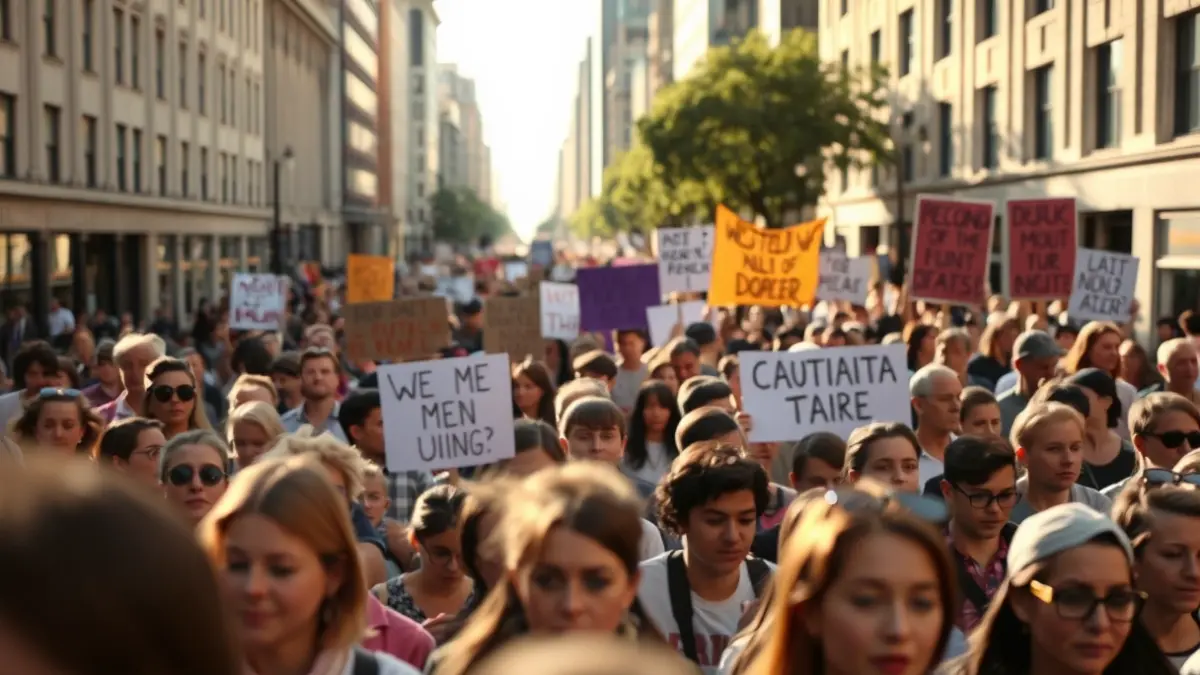
The march, organized by major trade unions, paraded through the streets of the Vallès city, highlighting that labor demands are closely linked to social and global issues. Participants expressed their concern about the international situation and its repercussions on the labor sphere.
“"We are at a moment when social and labor demands must go hand in hand because the consequences of what is happening globally also affect the world of work."
One of the highlighted concerns was the regularization of migrant people in Spain, emphasizing that many of them have been contributing to society for years. There was also strong criticism of hate speech and racism promoted by certain sectors, which seek to divide the working class.
“"The people who are being regularized have been working alongside us for many years."
In the purely labor sphere, unions highlighted progress in the negotiation of nearly 70 collective agreements in Catalonia. However, they lamented that these improvements are often diminished by the constant increase in prices of the shopping basket, rents, mortgages, and energy. The existence of millions of unpaid overtime hours in Catalonia was also denounced.
A critical point of the day was the denunciation of the 12 deaths due to work accidents recorded in Catalonia since the previous May Day. Union representatives emphasized the need to guarantee decent working conditions that allow workers to return home safe and sound, criticizing the business view on absenteeism.
“"We must complement decent wages and working conditions with measures that allow us to return home alive."
The procession began its journey in Plaça de Lluís Companys and culminated in Plaça Vella, where manifestos were read. The unified banner proclaimed: “Against wars and fascism, more rights and more unionism,” accompanied by chants such as “no to war” and “more wages and more rights.”
Unions noted a continuous growth in class unionism, with a significant increase in delegates, especially in small and medium-sized companies, where their presence was traditionally weaker. It was highlighted that the segment of the population that is unionizing the most in recent years is young people under 30 years old, thanks, in part, to recent labor reforms that have improved contractual stability.
Another central theme of the day was the employment regulation file (ERE) that the company Ficosa intends to apply at its Viladecavalls plant, affecting 172 workers. Unions consider the ERE illegal, arguing that it is not based on economic causes but on a disguised delocalization. They denounced that the news was communicated to the media before the workers themselves.
“"It is an illegal ERE because it is not based on economic causes, but on delocalization."
Union representatives assured that, although there will be layoffs, the objective is for them to be as least traumatic as possible and demanded an integral industrial plan to guarantee the future of the Vallès plant.