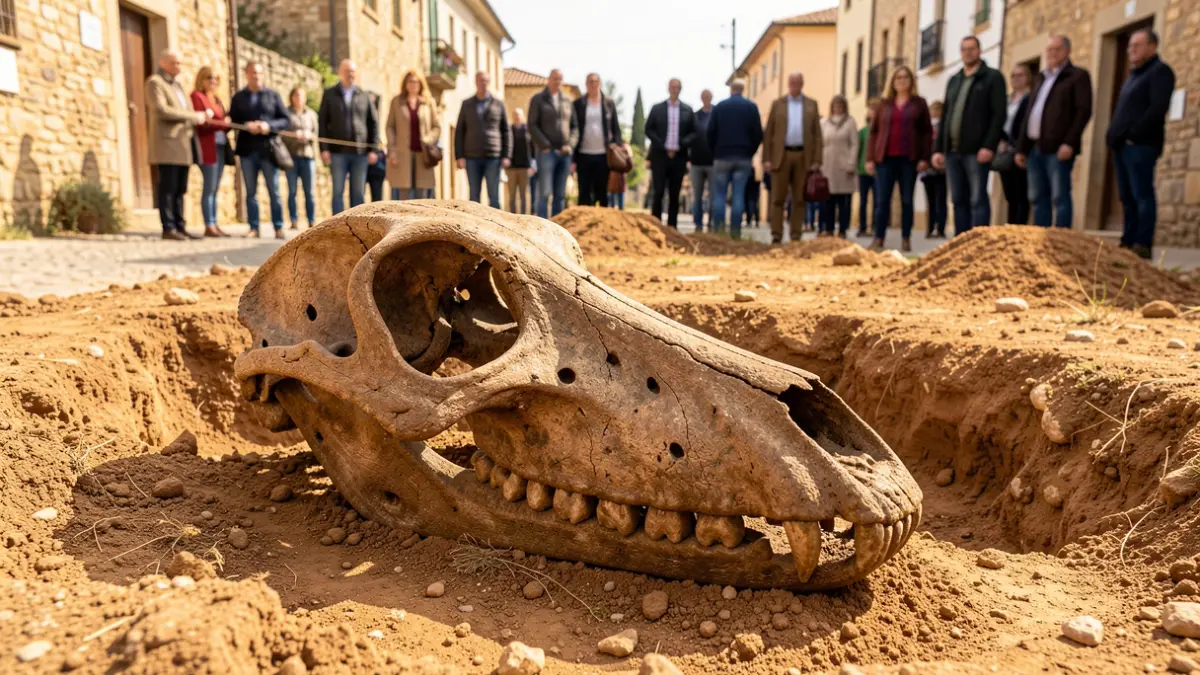
The review of a specimen found over thirty years ago at the Casots de Subirats site, in Alt Penedès, has allowed the Institut Català de Paleontologia Miquel Crusafont to identify a new species of bear-dog that lived in the area approximately 16 million years ago. The mammal, scientifically named Paludocyon moyasolai, is estimated to have been the size of a large dog, weighing between 50 and 70 kilograms.
The skull, originally found during excavations in the 1990s, was initially thought to belong to an already known species. It wasn't until 2014, during a thesis review, that doubts arose about its true identity, prompting a more in-depth study. This site is the first in the world where this specific species has been identified, reinforcing its international significance.
Previously, remains of the same family had been found at the Casots site, including the upper jaw and some teeth, as well as other similar fossils in different countries. These earlier specimens were considerably larger, comparable to a lion or tiger, weighing around 200 kilograms. The current conclusion is that the new skull belongs to a smaller, and likely less muscular, relative.
According to Isaac Casanovas, co-director of Casots and a member of the Paleontology Institute, the last two years have been dedicated to identifying and corroborating that no similar fossil had ever been found before. Paludocyon moyasolai is considered to be the most primitive species and, at the same time, the last of its evolutionary line to become extinct in the area. Casanovas emphasizes the responsibility of preserving this unique specimen, which will likely not be publicly displayed, although a replica is planned.
The identification of this new species will allow for deeper study into bear-dogs, which became extinct millions of years ago, and a better understanding of their family evolution. With this discovery, the list of vertebrates found at Casots now totals around 80. This area, formerly a lagoon surrounded by tropical forest, has facilitated the preservation of numerous fossil remains due to their absorption by the mud.
Paludocyon moyasolai is the first unusual carnivore found at Casots, which had previously recorded other unique discoveries such as Ampelomeryx ginsburgi, Eurolistriodon adelli, and Choeromorus ibericus. Annual excavations, lasting about two weeks, yield approximately 300 fossils.