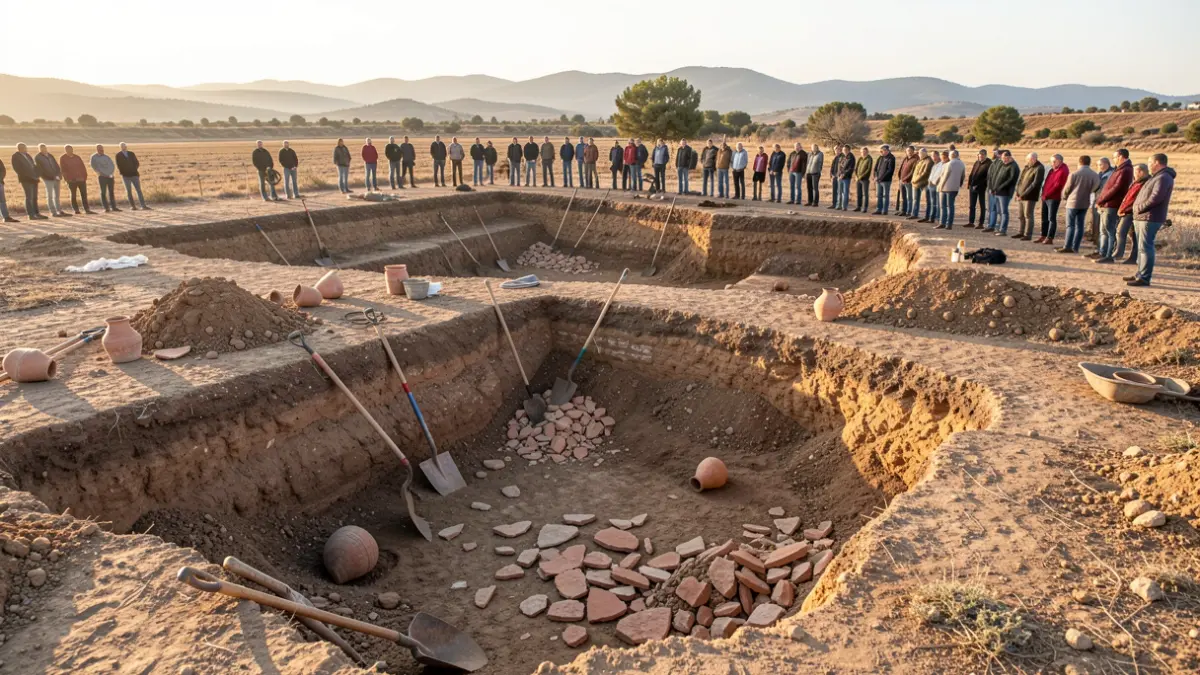
The irrigation system modernization works, funded by European funds and affecting 14 municipalities in the Empordà region, have led to the discovery of nine previously unconsidered excavation areas. The most significant find is located northwest of the Iberian settlement of Illa d'en Reixac, spanning approximately one and a half hectares within the ancient lakebed.
The unearthed remains correspond to habitats and structures from the Early Iron Age and the Iberian period. Until now, this area was thought to be devoid of human activity, but the findings suggest that inhabited spaces extended beyond the known nuclei of Puig de Sant Andreu and Illa d'en Reixac. This necessitates a revision of the understanding of the settlement, the lake, productive areas, and the territory's communication routes.
Among the discoveries is the complete documentation of an Early Iron Age hut foundation. Although remains from this period had been found in other nearby locations, this is the first time such a structure has been fully documented in the Ullastret area using modern archaeological methodology. This finding provides valuable information about the earliest human occupations preceding the consolidation of the Iberian city.
The materials found, from both the Early Iron Age and the Iberian period, are temporarily housed at the Ullastret site of the MAC and will be studied as part of a four-year project focused on the gates and access systems to the Iberian city.
The archaeological interventions have also documented sites in other municipalities of the Empordà. In Llabià, a medieval funerary and habitat space has been located. In La Tallada d'Empordà, sites with continuous human presence from the late Neolithic to the modern era have been identified. In Bellcaire d'Empordà, a large medieval granary and two 17th-century lime kilns stand out. Finally, in L'Escala, two new areas around the Roman city of Empúries have been excavated.
This program of archaeological interventions, linked to irrigation improvement projects, highlights the importance of preventive archaeology and its social utility. The effective coordination between project developers, archaeological teams, and administrations has allowed for the protection of cultural heritage to be balanced with the development of necessary agricultural infrastructure, demonstrating that archaeology can be an integral part of such projects.