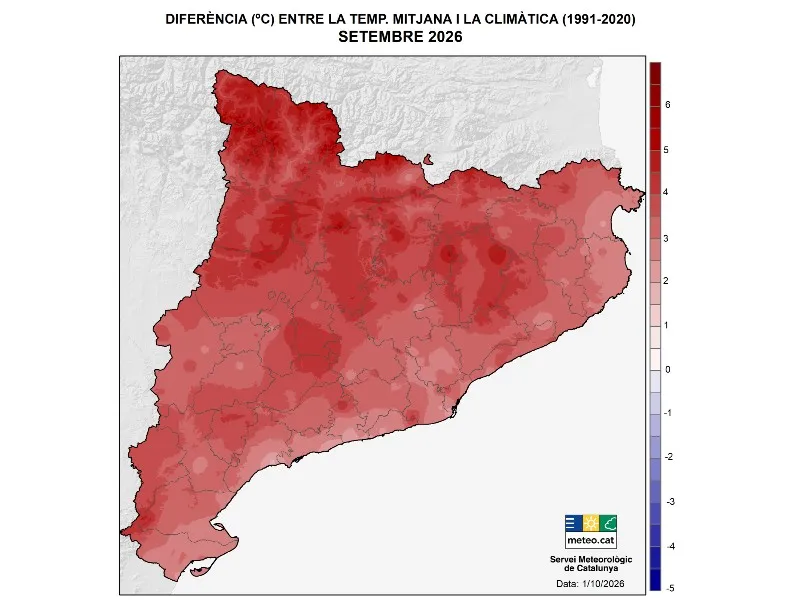
The monthly climate analysis reveals that September 2026 has surpassed historical heat records, ranking higher than Septembers in 1987, 2023, and 2018. The first half of the month was particularly heatwave-like, with temperatures more characteristic of summer than autumn, according to Aleix Serra, Head of Data Quality. This situation was due to a persistent anticyclonic wedge over the western Mediterranean.
The highest temperature was recorded in the Ribera d’Ebre region, with 42.5 °C in Vinebre, setting an absolute record for a September in Catalonia. The Fabra Observatory in Barcelona registered 35.5 °C, breaking its September record over the past 112 years. Although the Ebre Observatory did not break its absolute record, the average temperature was unprecedented, with 25 ºC for Fabra and 26.3 °C for Ebre, marking the warmest Septembers in their climatic series.
Regarding rainfall, the month was clearly divided. Western Catalonia experienced a dry or very dry month, with stations like Raimat (Segrià) recording only 0.6 mm, the driest September in its 38 years of data. In contrast, Eastern Catalonia was normal or rainy, with notable torrential storm episodes along the coast, pre-coast, and the inland plain of Girona, according to Anna Rius, Head of Climate Services.
Warm nights were concentrated in the city of Barcelona, with minimum temperatures exceeding 25 °C (tropical nights), particularly at the Barcelona – Can Bruixa station, which recorded 6 consecutive tropical nights. At the Catalonia level, the night of September 4th to 5th in Portbou – coll dels Belitres (Alt Empordà) marked the highest minimum temperature for September, at 28.5 °C.
The exceptional nature of the heat episode is reflected in the fact that 111 out of 128 stations in the Automatic Weather Station Network (XEMA) with over 20 years of data surpassed their September maximum temperature record, many of them with differences of up to 4 °C compared to the previous record.