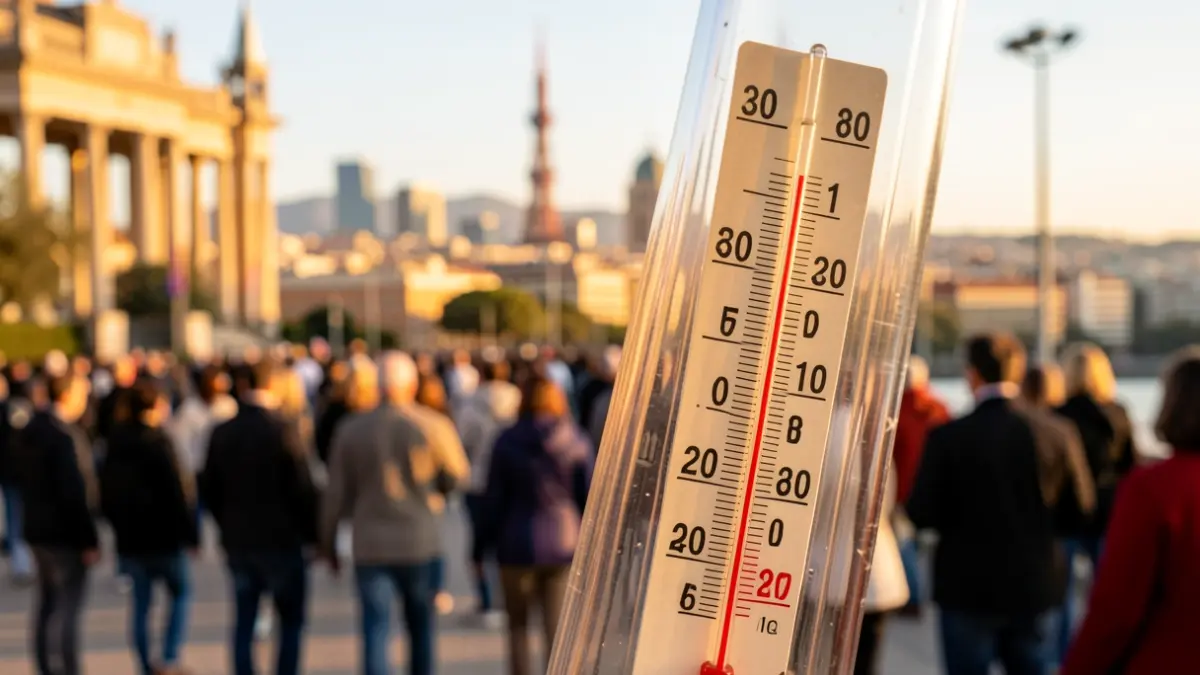
The first half of 2026 has solidified as the warmest period ever recorded at the Fabra Observatory – RACAB, surpassing all historical records since 1914. The average temperature from January to June has reached exceptionally high values, reflecting a trend of persistent and increasingly frequent heat in the city of Barcelona.
Data from the Fabra Observatory, which has monitored temperatures in Barcelona since 1914, shows a significant evolution. For much of the 20th century, annual temperatures remained relatively stable, fluctuating between 11 and 13.5 ºC without a clear trend. This pattern began to change in the late 1980s and, particularly, during the 1990s.
Since the 2000s, average annual temperatures have recurrently exceeded 14 ºC, a figure that was previously uncommon. In the last decade, this new range has become even more established. Recent years, such as 2022, 2023, 2024, 2025, and 2026, show very high values, with 2026 marking the absolute maximum in the entire historical series.
The latest years are notable for an unprecedented concentration of high temperatures: 15.38 ºC in 2022, 15.2 ºC in 2023, 15.28 ºC in 2024, 15.38 ºC in 2025, and 15.75 ºC in 2026. These are not isolated anomalies but consecutive years within the same elevated range.
The analysis of the data reveals that climate change is not manifesting as a linear and constant rise but through phased evolutions. After a relatively stable 20th century, a clear transition is observed at the end of the last century, followed by a markedly warmer recent period. This step-like evolution indicates that the climate is reorganizing around new temperature levels, turning previously extreme values into the new normal context.