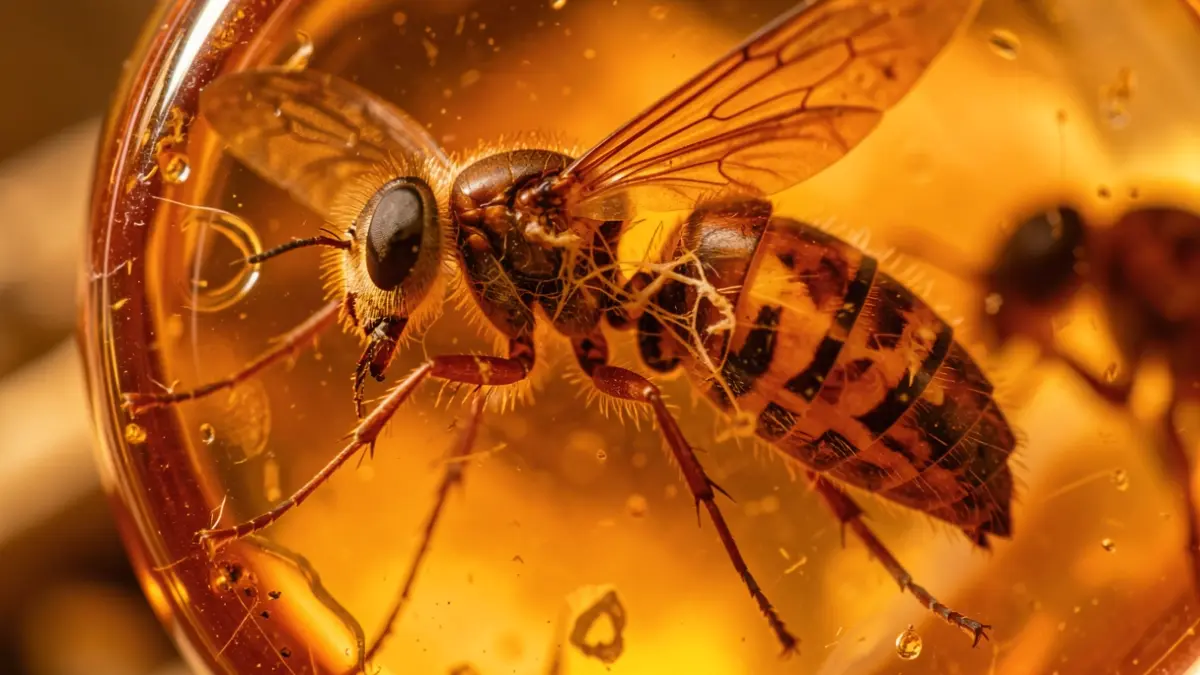
An international team led by the Institute of Botany of Barcelona (IBB, CSIC-CMCNB), with participation from the Institute of Evolutionary Biology (IBE, CSIC-UPF) and the Geological and Mining Institute of Spain (IGME-CSIC), has published new experimental results demonstrating that insects preserved in resin do not exhibit better DNA preservation than those kept outside this medium. In fact, some analyzed samples showed faster genetic material degradation in resin-trapped specimens.
The research, published in Scientific Reports, compared the DNA and internal tissue preservation of two insect species (the fruit fly and the flour beetle) trapped in fresh pine resin and specimens preserved outside and air-dried over 30 days. Molecular analyses confirmed that DNA degraded rapidly in both treatments, and resin inclusion did not enhance its conservation.
Researchers Xavier Franch and David Martín from CSIC at IBE explain that the assumption that resin isolated and dried organisms, promoting a form of mummification, might be incorrect. It appears that, in some cases, resin could maintain moisture, accelerating DNA degradation.
However, the study did find that resin can favor the preservation of certain internal tissues and organs. Synchrotron light tomography revealed that after 30 days, flies trapped in resin maintained internal structures like muscles largely intact, whereas those preserved outside the resin showed desiccated tissues. In beetles, while the general tissue structure was preserved, it appeared more degraded with increased gas bubble accumulation.
These findings reopen the debate on recovering ancient DNA from amber. David Peris, lead researcher of the study, concludes that the oldest DNA samples recovered from resin are only a few hundred years old, and it is highly probable that DNA preserved over millions of years will never be found.