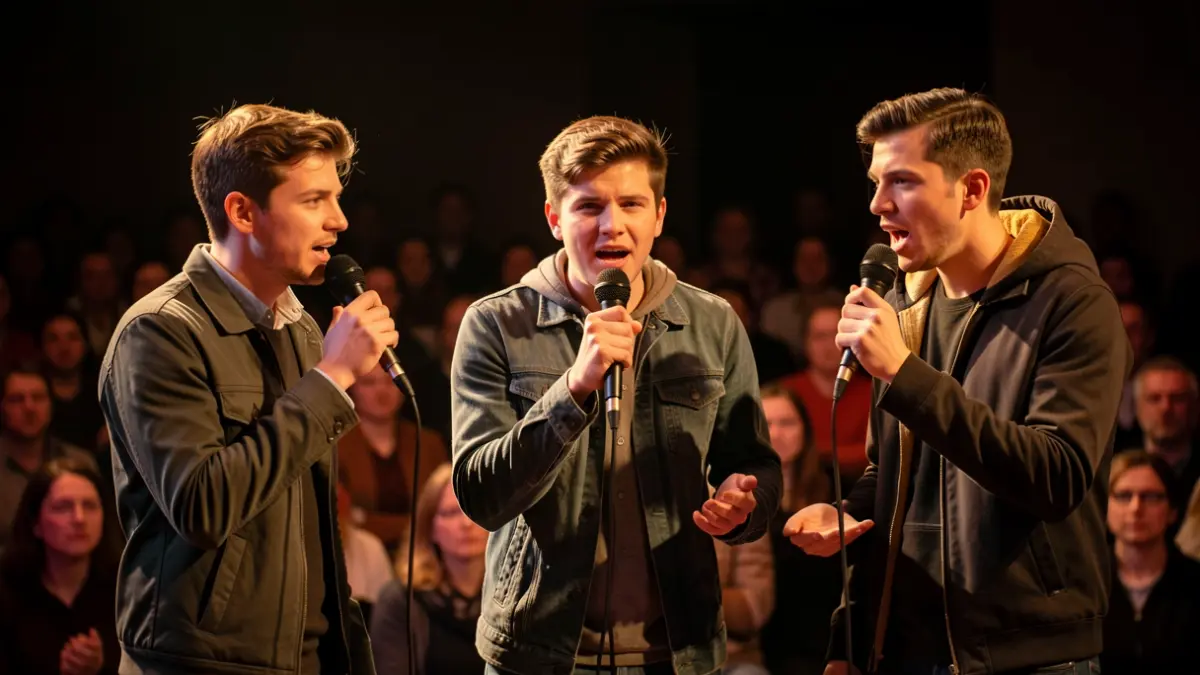
The Catalan podcast L'Arrabassada, created by Marc Lesan, Oriol Lapeira, and Iñaki Sola, three friends from Nou Barris born in 2000, recently won a Premi Crit for best entertainment project. The project began three years ago with the goal of changing their linguistic habits and stopping speaking Spanish amongst themselves after twenty years. They have produced over 70 episodes, traveling to different parts of the Catalan Countries.
The acceptance speech for the award, with a strong "Puta Espanya, Puta PSC i Visca els Països Catalans" (Fuck Spain, Fuck PSC, Long Live the Catalan Countries), went viral on social media. The creators admit they prepared it on the day of the gala, not expecting to win, and defend their "incendiary" intervention, arguing that many other speeches expressed similar ideas but with less "vulgarity". Aware that their stance might close doors, especially in public media like 3Cat, they address the current political situation with harsh criticism, recalling moments like the Urquinaona battle.
They criticize public television for awarding influencers who create content in Spanish and express skepticism about the loss of Barcelona's identity. They also question the situation in their neighborhood, Nou Barris, and the decline in street-level pro-independence activism. Criticism, they state, is a way of life and a means to make their generation reflect.
The creators explain they've known each other since school in La Prosperitat and, despite coming from Catalan-speaking families, they used to speak Spanish amongst themselves, reflecting Nou Barris's sociolinguistic reality. The shift to speaking exclusively Catalan was a conscious and initially embarrassing process, linked to their political engagement within the independentist left and the need for coherence with their project.
The podcast, defined as "from Nou Barris for all the Catalan Countries", reflects their vision of territorial fraternity, with episodes recorded in Mallorca, the Valencian Country, and Northern Catalonia. The project's mobility, self-managed with their own equipment, allows them to perform anywhere.
The podcast's "verbal radicality" is both their way of being and a tool to speak "without filters", something they find lacking in the often "politically correct" Catalan audiovisual scene. Self-funding allows them to maintain this freedom, setting them apart from other productions.
They consider it "impossible" for L'Arrabassada's format to be broadcast on TV3, citing La Sotana as an example of success outside public media. However, they don't rule out individual collaborations. They point out that Catalonia is "built on taboos" and that they try to address uncomfortable topics, from the right to the left, despite sympathizing with the independentist left.
They criticize the "censorship of the PSC" and the "censorship within their own space" in the independentist left, which can limit debates. Immigration is highlighted as a major taboo, which they admit is difficult to address but necessary to discuss with perspective, avoiding populism. They also point to the Catalan economic model's reliance on tourism and pork.
Regarding their viral speech, they explain they wanted to name "culprits" for the country's situation, beyond sectoral struggles like housing, and criticize Catalonia for being "tied to a state that exploits us" and a tourism model that "impoverishes and Hispanizes us".
While the speech may have closed "the door to returning to the podium", they didn't expect anything from public media. They mention that a well-known beer brand has never offered them sponsorship, despite having enough followers, and that they've heard comments about being "blacklisted".
The "Puta Espanya, Puta PSC" speech was an improvised but deliberate decision, aiming to break the "socialist pacification" and keep the independentist "flame" alive. They believe the social tension and drive for struggle from earlier times, like October 1st, have dissipated due to "socialist pacification" and the management by independentist parties.
They express disappointment with the policies of progressive governments and with independentist forces for not advancing towards separation from Spain. They criticize the PSC for supporting a neoliberal economic and social model and for achieving "nothing" despite their pactist approach.
The "folklorization of Catalan identity" refers to the reduction of Catalan to folkloric expressions or the hiring of creators who primarily produce content in Spanish for public media, which they find "insulting" and counterproductive to normalizing the language.
They acknowledge experiencing "Catalanophobia" with comments like "háblame en cristiano" (speak to me in Christian/Spanish), a reality affecting many Catalan creators. Regarding Barcelona, they express pessimism about the loss of Catalan essence, the trivialization of the landscape and linguistic presence, exacerbated by the erosion of social and associative fabric.
Concerning Nou Barris, they attribute the low use of Catalan to historical and demographic factors, the neighborhood's construction to accommodate rural migration, and the lack of spaces for using Catalan outside of education, as well as the perception of Catalan as an "imposition" or something for "elites".