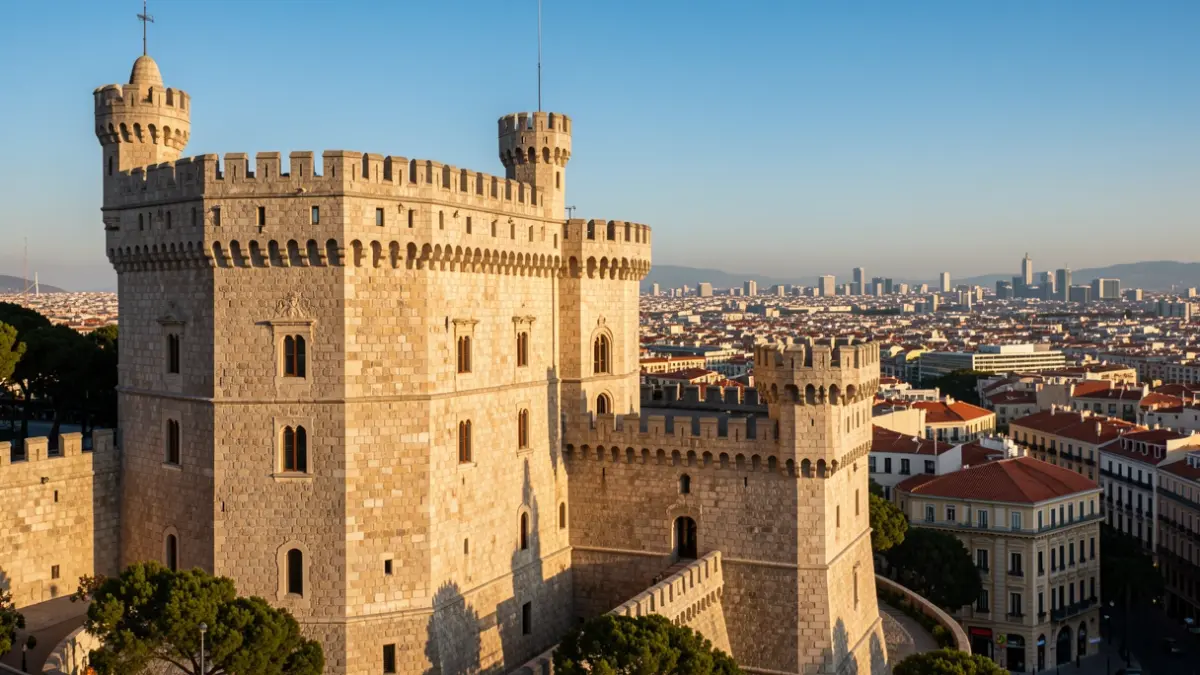
Montjuïc Castle, one of Barcelona's most iconic tourist attractions, features a revamped permanent exhibition at its interpretation center. Driven by the Institut de Cultura de Barcelona (ICUB), the display was curated by historians Josep Maria Vila and Ricard Conesa, who have expanded and enhanced the previous offering.
The new exhibition is divided into seven spaces, exploring the castle's history and its spatial, historical, social, and political context over ten centuries, with a particular focus on the last 300 years. Josep Maria Vila, who has overseen archaeological excavations at the castle since 2009, managed the older section, concentrating on its architectural and constructional evolution.
Ricard Conesa, in turn, contributed his expertise on the more contemporary period, especially concerning memory politics. The castle served as a prison for revolutionary social movements, republicans, and anarchists during the 19th century, often involving arbitrary detentions. A notable case is the 1909 execution of Francesc Ferrer i Guàrdia during the Setmana Tràgica.
The exhibition also recalls other events, such as the imprisonment of Filipino independence activists and the confinement of Nationalist supporters at the start of the Civil War. The figure of Lluís Companys, executed at the castle, stands as a symbol of the repression that took place there.
The curators aimed to move beyond mere "wars and battles," focusing on a new narrative that incorporates social and popular aspects, as well as the relationship between the city and the mountain during the 19th and 20th centuries. The display includes photographs, posters, historical timelines, sounds, and popular music, such as 19th-century revolutionary songs.
The exhibition details the castle's origins, starting as a signal tower documented in 1073, and its subsequent transformation into a fort in 1640. After its renovation from 1753 onwards, it became a center of repression, from which the city was bombarded three times (1842, 1843, and 1856) and numerous revolutionaries were imprisoned.
The exhibition spaces cover from the earliest human presence in Montjuïc (5,500-2200 BC) and the Jewish cemetery, to the Montjuïc stone used in constructions like the Eixample. It also highlights the bombings of Barcelona and anarchist attacks in the late 19th century, along with subsequent persecutions.