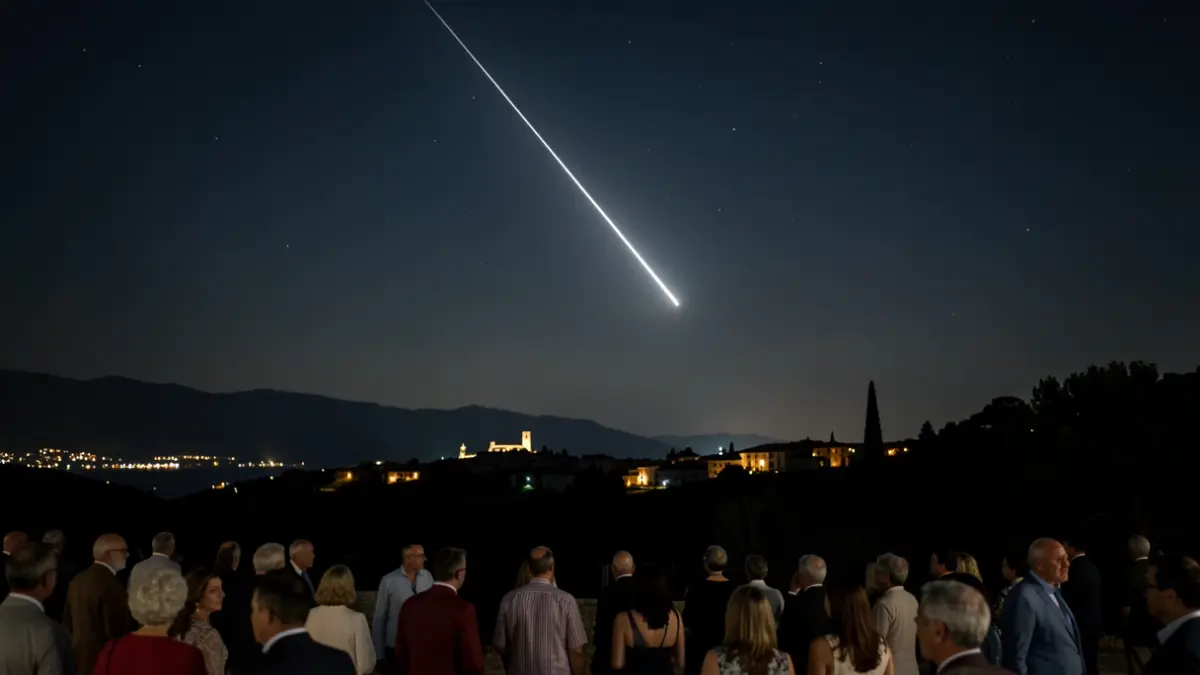
The skies of Catalunya were briefly illuminated last night by the presence of a superbólido. This fireball, resulting from the fragmentation of a high-speed rock entering Earth's atmosphere, was detected around 2:30 AM from various points across the territory. Sources from the Network for the Investigation of Bolides and Meteorites (SPMN), coordinated by the Institute of Space Sciences (CSIC-IEEC), confirmed the event.
According to a scientific researcher from ICE-CSIC, a bolide is defined as the luminous phenomenon arising from the ablation of a rock from interplanetary space that impacts the atmosphere at hypervelocity. The distinction from a meteorite lies in whether the rock survives the journey and reaches Earth's surface.
The rock fragment, termed a meteoroid, travels at relative speeds of tens of kilometers per second. When Earth intercepts it, the high-speed interaction with atmospheric components generates a luminous trail known as a meteor. The brightest meteors are called bolides, and their study allows for trajectory reconstruction and deduction of potential meteorite fall sites.
The superbólido on June 25th was captured by a dozen videodetection stations located in Catalunya and Valencia, including sites like Pic Bartolo, Breda-Girona, Catarroja-València, Esparreguera, Folgueroles, Gavà-Colomeres, Observatori del Montsec, Observatori de Pujalt, Sant Fost de Campsentelles, Sant Mateu, and Vallirana. It was also registered by a French station in Marseille.
Researchers are still working on a detailed reconstruction of the phenomenon, but they estimate the entry speed into the atmosphere was approximately 140,000 kilometers per hour. This is a very luminous event, classified as a superbólido, which can be observed only a few times a year in the region.
“"The Network for the Investigation of Bolides and Meteorites is a citizen science project of iCE-CSIC with over 30 years of history and three recovered meteorites."
This network, with over 30 years of history, has successfully recovered three meteorites, breaking a 57-year streak without previous recoveries in Catalunya.