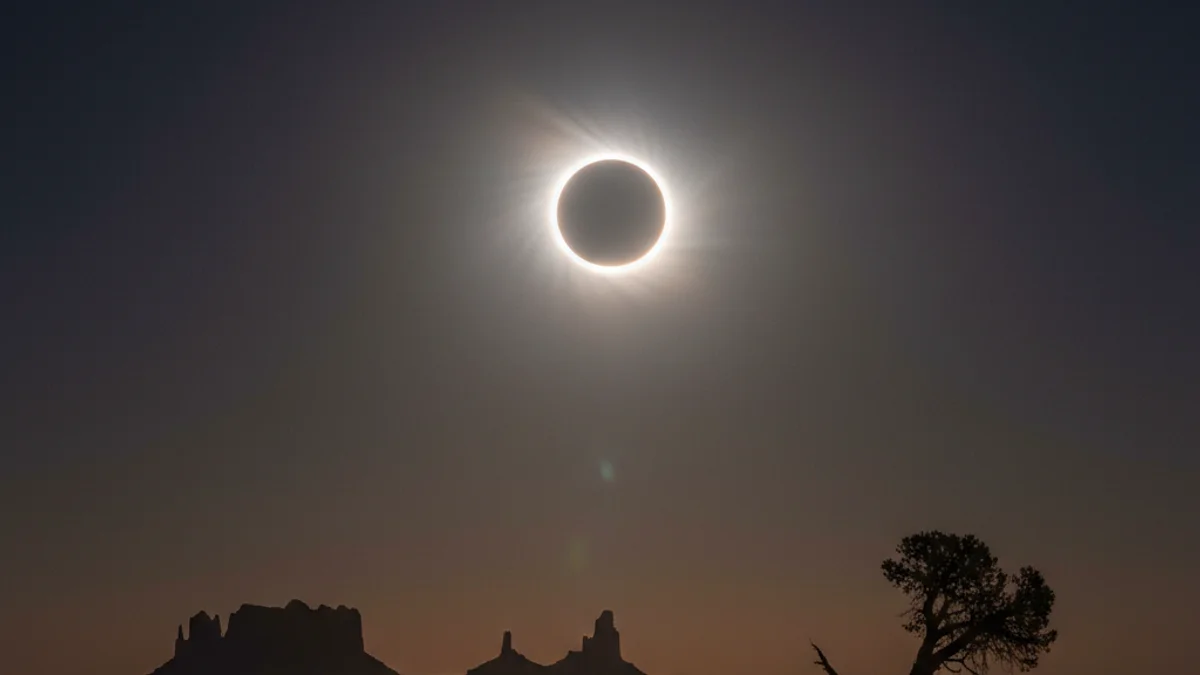
This spring was marked by a special astronomical event: a mixed or hybrid solar eclipse, a phenomenon that only occurs twice per century. This type of eclipse is characterized by starting as annular, transforming into total, and becoming annular again before ending, a cycle that causes a surprising darkening of the sky. NASA highlighted its rarity, noting that a similar event had not occurred for 18 years.
The hybrid eclipse is characterized by progressively darkening the sky and revealing what is known as the 'ring of fire,' which are the edges of the sun.
Out of the 223 solar eclipses that will occur throughout this century, only 7 will be mixed (annular/total), underscoring the event's significance. Unfortunately, the eclipse, which the space agency named Ningaloo (referencing an Australian coral reef), was not visible from Spain or any part of Europe. Visibility was concentrated in Southeast Asia, the Philippine Islands, and Oceania.
According to the Spanish National Geographic Institute, the partial eclipse began on April 20 at 3:34 AM (Spanish peninsular time) in the Indian Ocean and ended at 8:59 AM in the Pacific Ocean. The total duration of the phenomenon was 325 minutes. The maximum of the mixed eclipse occurred at 7:17 AM southeast of East Timor, with a maximum duration of 1 minute and 16 seconds.
Despite the impossibility of viewing the hybrid phenomenon from the peninsula, citizens in Spain were able to observe the second eclipse of the spring. This was a penumbral lunar eclipse that occurred on May 5, visible throughout the territory except in the northwest of the Peninsula and the Canary Islands.