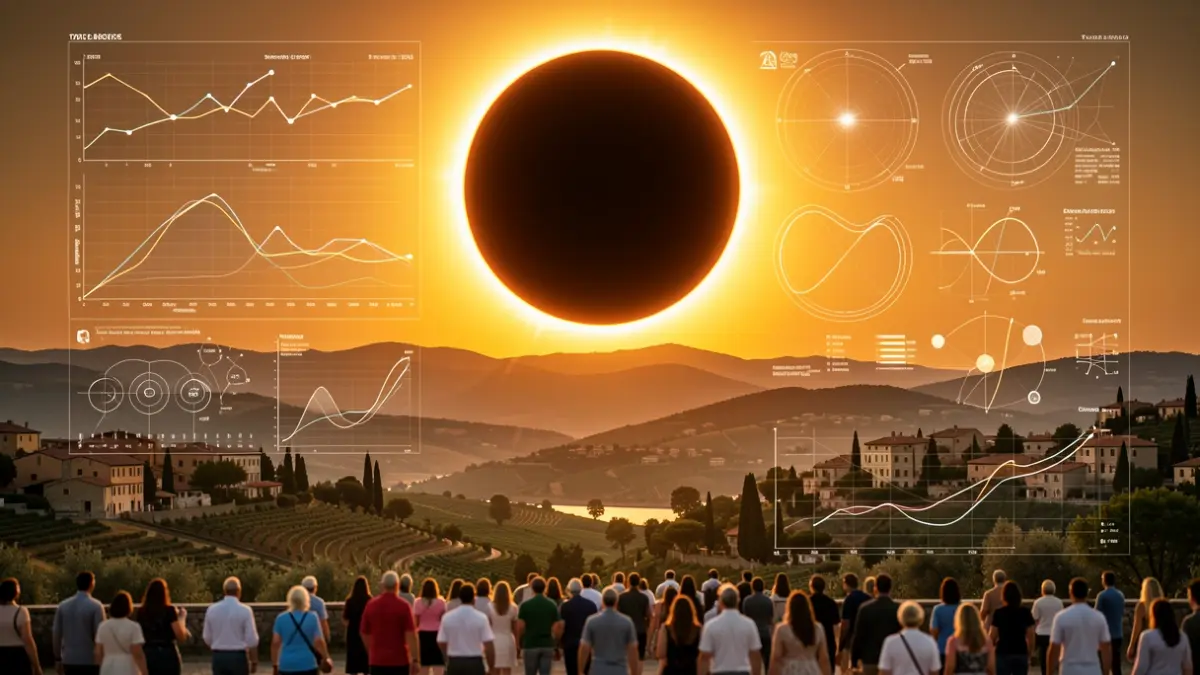
The project, named Solaris, aims to measure physiological changes such as heart rate, breathing, and emotional response in individuals during this exceptional astronomical phenomenon, the first of its kind visible in the area for over a century.
The research, presented by the Minister of Research and Universities, Núria Montserrat, will utilize anonymous data collected via smartwatches and other wearable devices. Participants will need to download a specific application from the Catalan Institute for Space Studies (IEEC) portal to record their parameters before, during, and after the eclipse. Subsequently, the Vall d'Hebron Research Institute (VHIR) will analyze the information.
The Generalitat aims to gather at least 5,000 participants, especially among the more than 50,000 attendees expected at the observation points set up in Lleida, Tarragona, and Terres de l'Ebre, although participation will be open to anyone.
Montserrat described the event as a "massive citizen science experiment," emphasizing the importance of public collaboration in understanding whether such an extraordinary phenomenon can cause measurable alterations in the human body.
Previous research has already shown how total solar eclipses affect animal behavior, causing birds to stop singing or insects to interrupt their activity. The Solaris project seeks to verify if these effects also extend to humans, generating measurable physiological changes.
The first conclusions from this study are expected to be released by the end of September.