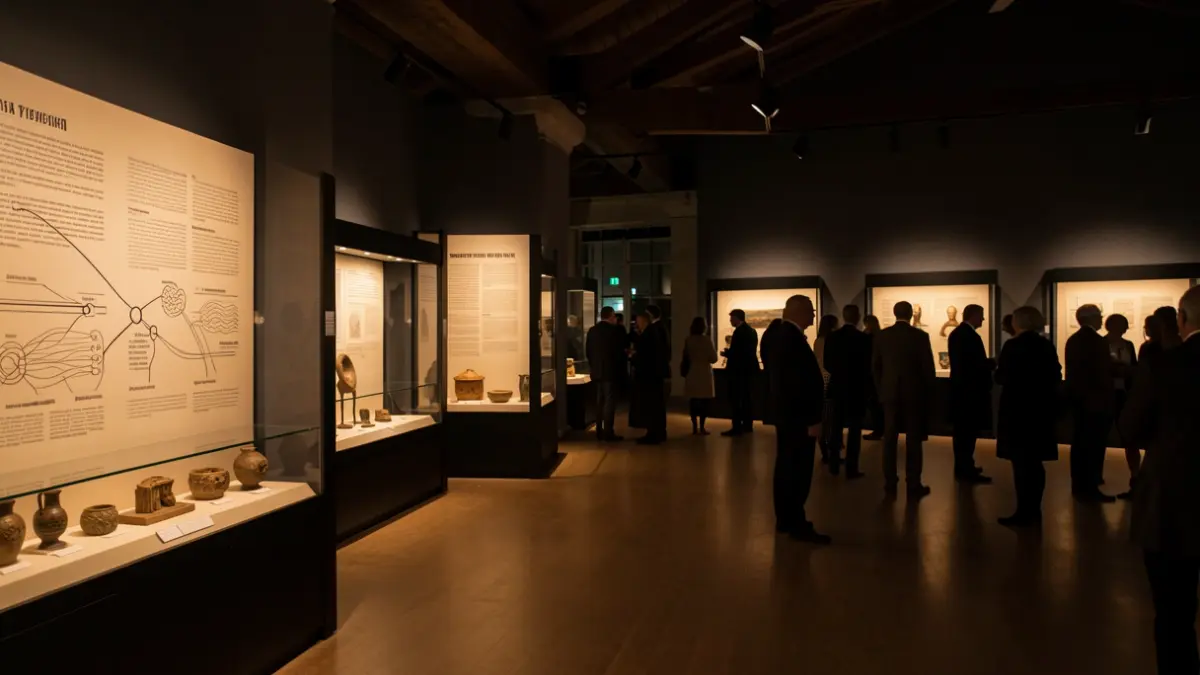
The exhibition 'Mediterranean Gaze', inaugurated in March at the Castell de Vila-seca, focuses on the figure of Joaquim Sorolla and his connection with Camp de Tarragona. Featuring around fifty works by fifteen artists, the exhibition, running until September 14th, explores Mediterranean landscape, light, and culture, while also highlighting the Valencian painter's ties to the region, particularly Reus.
Seven pieces by Sorolla hold a prominent place, showcasing his interpretation of the Mediterranean. Curator Damià Amorós notes that the painter's presence is the 'keystone' of the exhibition, enabling the development of the narrative on the artistic vision of the Mediterranean and the discovery of 'another Sorolla' and 'another artistic vision of our surroundings'.
The exhibition emphasizes Sorolla's relationship with Camp de Tarragona, often overshadowed by his association with Valencia. Amorós argues that this link 'is not anecdotal' but includes 'friendship and admiration' with elements of the territory, such as the figure of Marià Fortuny, the monastery of Poblet, and the Count of Artal.
The influence of Marià Fortuny, a painter from Reus, is key to understanding Sorolla's connection with Reus. According to Amorós, Sorolla traveled to Rome to be closer to Fortuny and even acquired a small table by the Catalan painter. Their biographies share significant family, social, and formative parallels that facilitated Sorolla's approach to Camp de Tarragona.
The mutual admiration is reflected in how both artists found much of their 'creative corpus' in the light, skies, beaches, and coves of the Mediterranean.
Sorolla's fascination with the monastery of Poblet, a cultural symbol of the 19th century, is also highlighted. Amorós explains that Sorolla saw a connection there with the royal pantheon and Jaume I. The Sorolla Museum in Madrid preserves correspondence and a piece from a Poblet altarpiece.
The painter also visited El Serrallo in Tarragona while preparing his work 'Catalunya, el peix' (Catalonia, the Fish), demonstrating his interest in the southern Catalan coast, even though the final composition incorporated elements from Girona and Barcelona.
The exhibition revisits Sorolla's lesser-known relationship with Antoni Gaudí, met in Barcelona around 1915, possibly through Eusebi Güell. Sorolla expressed 'admiration for Gaudí's work', further strengthening his indirect connection with Reus and Camp de Tarragona.
The Museum of Reus holds two works by Sorolla, one of which is displayed at the Castell de Vila-seca. Amorós champions the museum as a significant institution, even though these pieces are not part of the permanent collection, as Sorolla 'is not from Reus', although the painter 'would have been delighted to share space with Fortuny, Gaudí, Galofre, Mir, or Tapiró'.
The exhibition underscores Sorolla as a great Mediterranean painter, with intense light, the movement of the sea, and coastal landscapes as central themes. Artists such as Joaquim Mir, Baldomer Galofre, Martí Alsina, and Sorolla himself engage in a visual dialogue focused on the Mediterranean landscape.
Amorós highlights Martí Alsina as a fundamental figure in this artistic genealogy, considering him the 'father' who connects with the Barcelona School of Llotja and extends to Tarragona. The exhibition aims to 'reconnect Camp de Tarragona with its artistic and Mediterranean memory'.
The curator also regards the Castell de Vila-seca as a 'top-tier cultural hub', noting its over 50,000 visitors in a decade and its commitment to national-level exhibitions, solidifying its role as a key element in the cultural fabric of the region and the country.