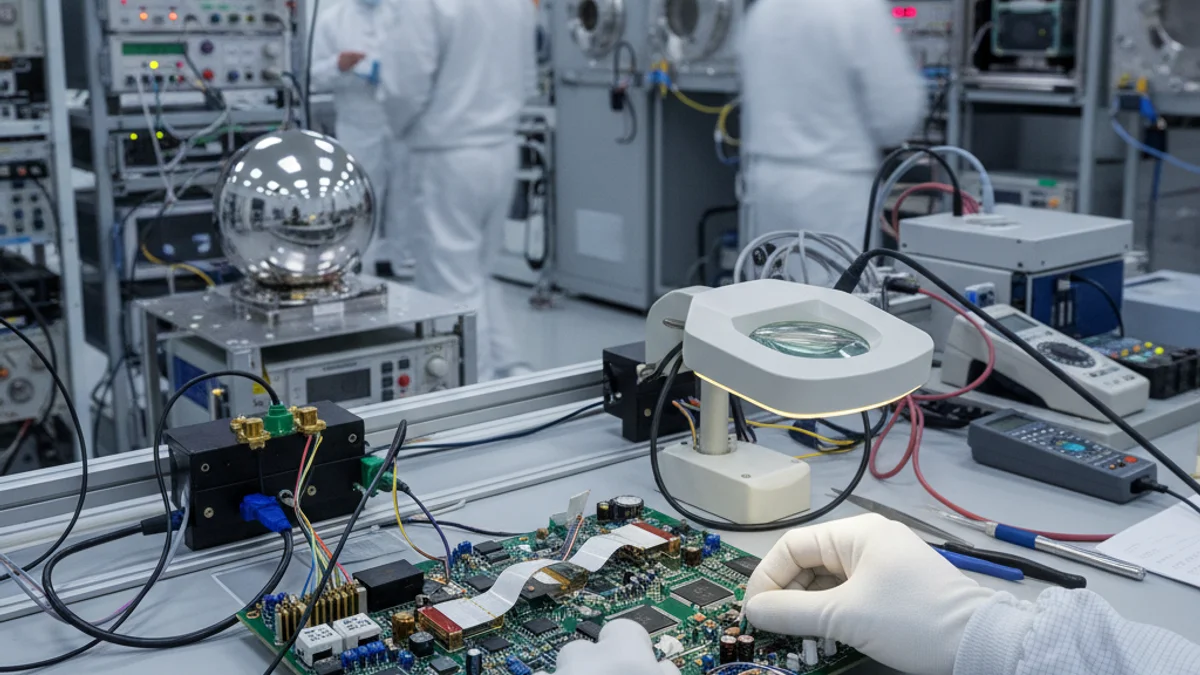
Manel González (Tarragona, 1990) began his international career 15 years ago when he moved to Toulouse on an Erasmus scholarship while studying at the URV. After obtaining his doctorate in electronic technology capable of surviving extreme temperatures and space radiation, he was hired by the CNES, the French space agency, where he is currently an expert in electronics and electromagnetism.
“"My job is similar to a hospital emergency room, but with breakdowns. My patients are electronic components that mysteriously fail in the final phases before being integrated into the instruments."
His work is crucial to prevent delays in high-risk projects, as he must quickly find the cause of failures and propose solutions. González actively participates in NASA's Dragonfly mission, which will send a 450-kilogram drone to explore Titan, Saturn's largest moon. He contributed to the development of DraMS, a key instrument for analyzing the chemistry of this world, considered highly promising for astrobiology.
Furthermore, he is part of the team for Athena, the European Space Agency's (ESA) future X-ray telescope, designed to observe invisible phenomena such as black holes. The technical challenge is extreme: the detector must operate at 50 millikelvin (about -273ºC), and González works on the complex electrical connection that allows this operation without heating the system. He also participated in the Japanese mission Martian Moons eXploration to study Mars's moons, Phobos and Deimos.