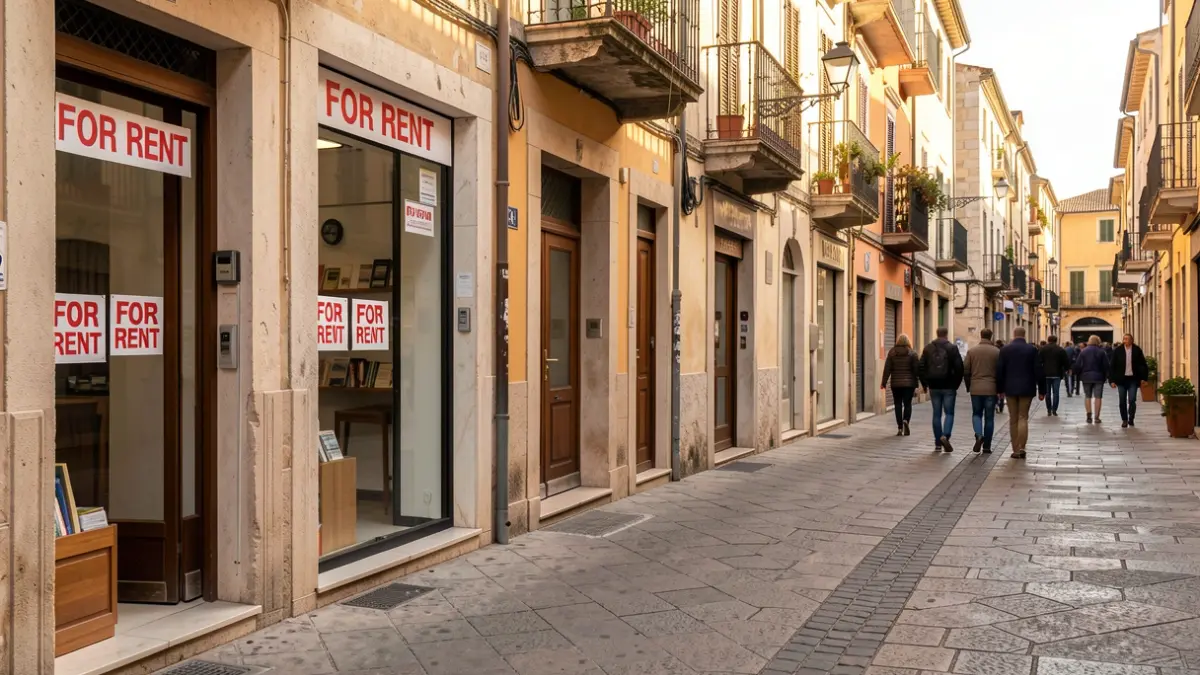
The city of Terrassa is undergoing a progressive transformation of ground-floor commercial spaces into residential units. However, a study commissioned by the municipal government advises against this trend in strategic commercial zones to consolidate them. The areas affected by this recommendation include sections of Arquimedes-Volta-Pare Llaurador streets, Arquimedes-Doctor Salvà, the area around Nacions Unides, the Matadepera road, and Periodista Grané street (in Sant Pere Nord) and Matagalls-Sierra Nevada (in Les Arenes).
The study, conducted by Estudi 300.000 km/s and presented by urban planner architect Mar Santamaria, also notes an evolution of these spaces towards service-oriented premises and identifies recognized but not yet fully consolidated commercial hubs. In Terrassa, 89% of ground-floor premises (10,601) are registered, of which 25% (2,643) have no declared activity, although some are used for tourism. Of these, 40% are allocated to services, 31% to commerce (with a third dedicated to food), and 29% to other uses. In terms of surface area, the categories of services, commerce, and industry are balanced, even though most premises are small (under 700 m²), large spaces (over 2,000 m²) account for a significant portion of the total area.
Since 2015, the opening and closing of commercial premises have remained relatively stable, with a slight decrease in activity since 2023. The study points to a clear "trend towards the progressive substitution of productive space for housing on the ground floor," a phenomenon that Santamaria describes as "residential pressure," exacerbated by the city's demographic growth of approximately 4,000 inhabitants per year.
Over the past decade, only 14 changes of use from residential to commercial have been registered (with 12 licenses granted), while 64 out of 85 applications for various residential typologies have been approved, along with 127 out of 168 for multi-family housing. "Like in Barcelona, there is beginning to be pressure from housing to occupy ground floors," the architect reiterated.
Therefore, it is proposed to "curb the change of use towards housing" in commercial hubs intended for consolidation. For recognized but unconsolidated hubs, such as those in the Commercial Equipment Orientation Program (POEC), a lack of "density or specialization" is detected, often conditioned by the size of the premises or the predominance of housing. This situation affects sections of Josep Tarradellas and Jaume I avenues, Creu Gran street in the Centre, parts of Sant Pere, and Hispanitat and Francisco de Vitoria streets (in Can Boada), as well as the small streets of Montcada and Castellar.
In contrast, other areas and sections of the city have already consolidated as commercial hubs. The study also plans for the creation of new connecting axes to improve the commercial network and serve new urban developments, particularly in the northwest.
The Councilor for Urbanism and Commerce, Xavier Cardona, positively assessed the POEC's effectiveness but acknowledged the city's transformation and the arrival of new residents. He highlighted the interest of "large operators" in establishing themselves in the city, such as the construction of a new Consum supermarket on Santa Maria de Mazzarello avenue, an area not initially considered commercially significant.
Cardona also noted a shift in consumption patterns, which, while remaining "very present" outside the textile sector, shows new trends. Large establishments are improving their offerings of fresh produce and prepared meals, and there is a return to customers collecting products in-store, reducing reliance on delivery services like Glovo. Additionally, the restaurant sector is expanding.
Regarding areas with commercial stagnation, such as the Montcada road with the Segle XXI complex, an upturn is expected with the rehabilitation of the former Sala i Badrinas factory and the establishment of a new BonPreu supermarket. The reopening of previously vacant premises in the Can Boada neighborhood has also been highlighted.
On the issue of rising rents, particularly in central areas, Cardona revealed that the City Council is considering purchasing some premises to prevent their conversion into businesses that detract from the area's unique identity. However, he believes this option is "limited by the type of tender process" available.