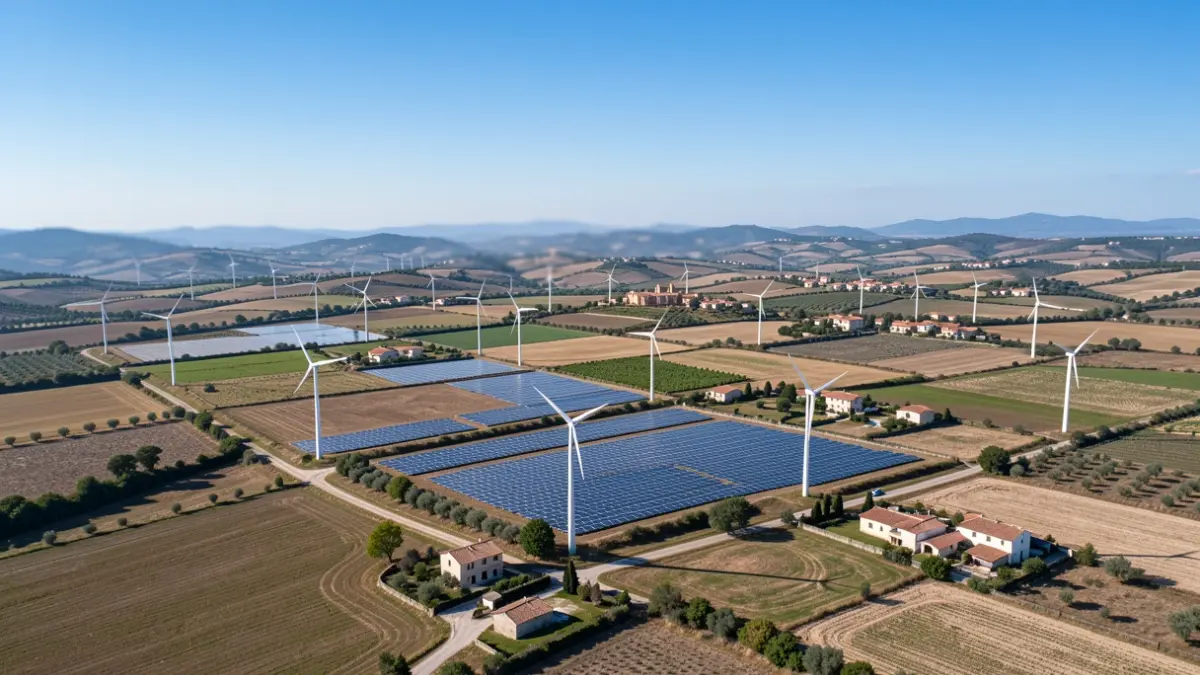
The Territorial Sectorial Plan for the Implementation of Renewable Energies in Catalonia (PLATER) is provoking strong rejection in numerous municipalities across the region. Local administrations believe their voices have not been sufficiently heard, warning of "pharaonic" projects that could endanger tourism and biodiversity in the affected areas. In the Terres de l'Ebre, for instance, criticism is leveled at the "unfair and inequitable" price imposed. Meanwhile, from the Girona regions, a manifesto has been promoted, now supported by over 180 town councils from about thirty counties, demanding a halt to the plan's processing. The Government, on its part, defends the "necessity" of PLATER to "organize" the energy transition and avoid "macro-projects" and "expropriations".
The PLATER document identifies areas with the highest potential for new wind and photovoltaic power, setting minimum generation targets for counties and municipalities. The Segrià, Anoia, and Garrigues are among the regions identified with high potential for new installations.
In the Anoia county, PLATER forecasts a generation capacity of 3,340 MW, making it the second-highest potential county, surpassed only by Segrià. This projection causes concern among local mayors, who are already preparing objections. A prime example is Rubió, a municipality of just over 200 inhabitants, which already has 50 wind turbines and the plan foresees adding 35 more, each 200 meters high, plus over a hundred hectares of solar panels.
The mayor of Rubió, Francesc d'Assís Sillero, criticizes the "very non-transparent planning" that is "disconnected from the territory." He denounces the lack of consideration for proximity to farmhouses and scattered settlements, stating that "without these minimum distances, people will have to leave because you cannot live with a 200-meter-high monster next to your home." Sillero laments that the municipality "has already contributed" to the energy transition and considers it unfair to bear "a part of the county quota" when other municipalities like Igualada face no impact.
Mayors in Anoia are organizing to oppose PLATER, aiming to pass a motion against it at the next Council of Mayors. According to Sillero, "we are more or less half the county who are against it."
This initiative from Anoia is part of a broader movement in Catalonia, initially emerging in the Girona regions. Over 180 town councils from about thirty counties have formed a cross-party group for territorial defense and will oppose the current PLATER proposal. This group will establish the Association of Municipalities for the Reform of Plater (AMRP) and will deliver a joint manifesto to the President of the Generalitat, Salvador Illa.
The councils believe the plan was drafted "without real and effective input from local communities or the territory as a whole." They demand the suspension of its processing and a meeting with the President of the Generalitat. The mayor of Viladasens, Xavier Sánchez, one of the promoters, points out that "more than 180 municipalities across Catalonia" demonstrate that PLATER "has not taken municipalities into account."
Furthermore, they are working to present a Resolution to the Parliament of Catalonia to suspend and review PLATER's territorial model, seeking to "guarantee territorial balance, participation, and local autonomy." They believe the union of these municipalities will force dialogue to redirect the strategic territorial planning for the construction of new renewable energy plants.
In the Girona regions, the municipalities of Viladasens (Gironès) and Vilademuls (Pla de l'Estany) have the largest surface area affected by PLATER, with a high percentage of impact across Catalonia. The mayor of Viladasens, Xavier Sánchez, believes that the municipal layer should be "layer zero," even though ICAEN claims to have considered 141 layers. Sánchez advocates for reforming the decree and proposes creating small solar plants for an "energy commonwealth," feeding surplus power into the grid as "solidarity" with urban areas.
The mayor of Viladasens favors exhausting rooftops and already developed areas before resorting to "macro energy projects" that involve losing agricultural land and landscapes, warning of risks to "food sovereignty" and "biodiversity." He argues that the Generalitat's environmental regulations already prioritize developed spaces. He considers that PLATER contradicts these regulations and encroaches on municipal powers, as "the Statute of Autonomy grants full competence to municipalities for territorial planning."
From the Terres de l'Ebre, it is also criticized that PLATER "exceeds municipal sovereignty." The mayor of L'Ametlla de Mar, Jordi Gaseni, regrets that the Generalitat will impose the plan despite local urban planning modifications to contribute to renewables without impacting the landscape. They offer "already anthropized" spaces like industrial estates but warn of risks to heritage elements such as "centuries-old olive and carob trees or dry stone constructions over 200 years old."
In Baix Ebre, PLATER assigns 509.7 MW of solar energy and 1,261.9 MW of wind power, figures significantly higher than current ones. The county, the fourth-largest producer of wind energy, is identified as the tenth with the most potential. Gaseni argues that the county already "makes a great effort" and "is already contributing to energy generation" due to its proximity to the nuclear power plant.
Terra Alta demands to be "shielded" from wind energy implementation until 2030, arguing it has already contributed sufficiently by producing 25% of Catalonia's wind energy. The County Council and the platform Terra Alta Viva will submit amendments to PLATER, which identifies the county as the tenth with the most potential. It is projected that the county will quadruple its wind power production, reaching 1,792.6 MW by 2050, in addition to photovoltaic power.
Núria Altés, spokesperson for Terra Alta Viva, denounces that the wind energy targets are "unachievable" and that they are being asked to pay an "unfair renewable energy tax." She criticizes that the "existing wind power saturation" has not been considered and that promises have been "empty," leaving them feeling "deceived."
The county fears that PLATER will open the door to wind turbines near the "rich agricultural mosaic," jeopardizing the wine and enotourism sector. Jordi Gaseni, from L'Ametlla de Mar, notes that the plan allows wind turbines to be installed near the coast, 200 meters from beaches, and that this will not be accepted by local tourism as it might be in other European cities. He calls for a more balanced distribution of "energy solidarity."
In Tornabous, Urgell, mayor David Vilaró criticizes that the plan harms rural areas, affecting "quality agricultural land" and being "detrimental to food production" and the population. They estimate that about twenty hectares of agricultural land will need to be converted into solar installations, "the equivalent of 20 football fields."
From Unió de Pagesos, it is questioned that the Government reserves "300,000 hectares as a priority zone." Salomó Torres, head of Pagesia Gran, encourages submitting objections and ironically notes that the Terres de l'Ebre, which already produces 22% of wind energy, has more "suitable" zones. He argues that "equity means distributing the impact" and that there is solar and wind potential throughout the territory, including Barcelona.
The Minister of Territory and Ecological Transition, Sílvia Paneque, defended in Parliament that PLATER is "the tool to avoid macro-projects" and that town councils have "open doors" at the Department to "work together." She assured that "everyone will participate" and that meetings have been held with mayors who requested them.
The CEO of l'Energètica, Daniel Pérez, defends that an "effort" has been made for an "balanced" distribution of renewables, prioritizing projects in counties "that are lagging in achieving PLATER goals" to "generate territorial balance."