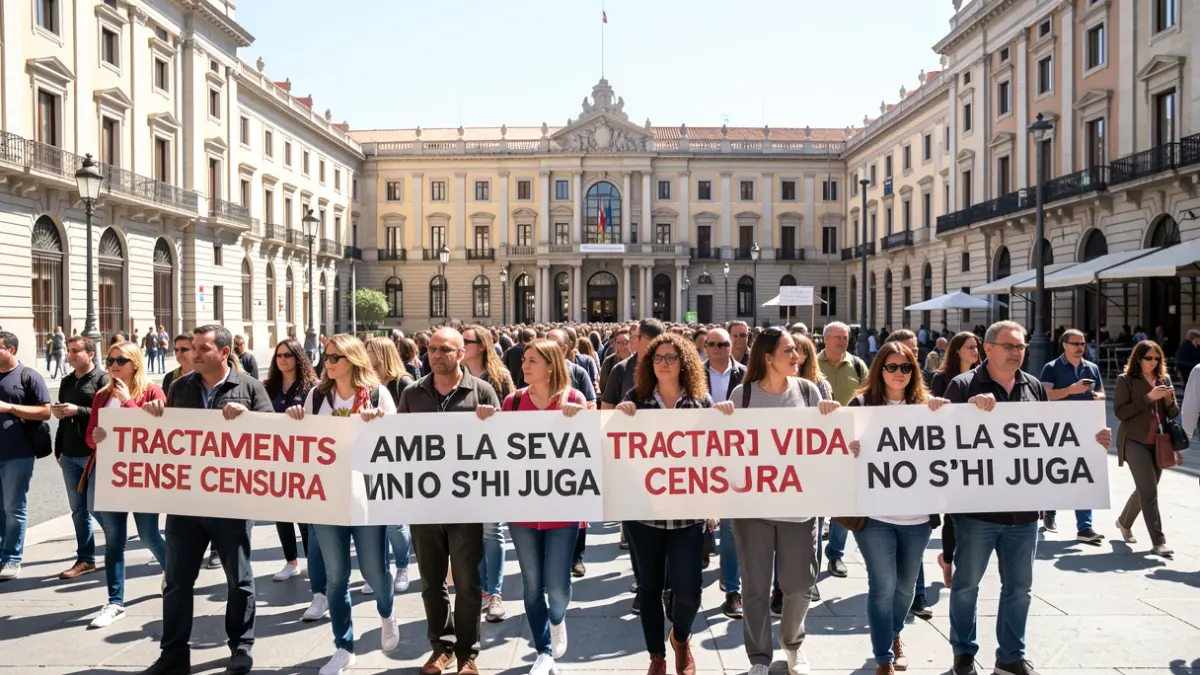
These measures are part of the pacification of the last section of Meridiana Avenue and aim to prioritize public transport to alleviate traffic problems, especially during peak hours. The goal is for interurban lines to gain commercial speed and reduce congestion at the city's entrances.
One of the proposals analyzed is the relocation of the Fabra i Puig station to an underground site beneath the park located between Río de Janeiro Avenue, the Porta Football Field, and Andreu Nin Street. This relocation would allow for an increase in its surface area to accommodate between 20 and 27 bus bays, although the necessary investment is pending evaluation by municipal sources.
“"Offering a good public transport service is the only way to pacify Meridiana."
Currently, the Fabra i Puig station functions as an interchange for interurban bus users and the L1 metro line, which are often saturated during peak hours. The diversification of flows, by diverting part of the passengers to other TMB urban bus lines, is one of the solutions being studied to decongest these points.
The analysis of mobility at the city's access points is based on the premise that adding more lanes for private vehicles is not an effective solution. Traffic problems are mainly concentrated between 7:00 and 9:00 in the morning at the entrances. The City Council aims to double the number of bus users, reaching approximately 400,000 daily passengers, ensuring a fast and efficient service.
To achieve this, the creation of double bus lanes at the city's entrances is planned, including Diagonal Avenue and the northern and southern ends of Gran Vía. These lanes would be designed to separate urban buses, with more frequent stops, from interurban buses, which would have a more direct lane to underground intermodal stations. New stations are already planned for Plaça Espanya and La Sagrera, and another is being studied for the Diagonal entrance.
The remodeling of the third section of Meridiana Avenue, from Fabra i Puig to the city exit, will involve dismantling the current urban highway to transform it into a road with two carriageways separated by a landscaped median. This reform seeks to urbanistically integrate both sides, eliminating the wall and the segregated lane on the Sant Andreu side and the Can Dragó bridge, and will include a bidirectional bike lane.