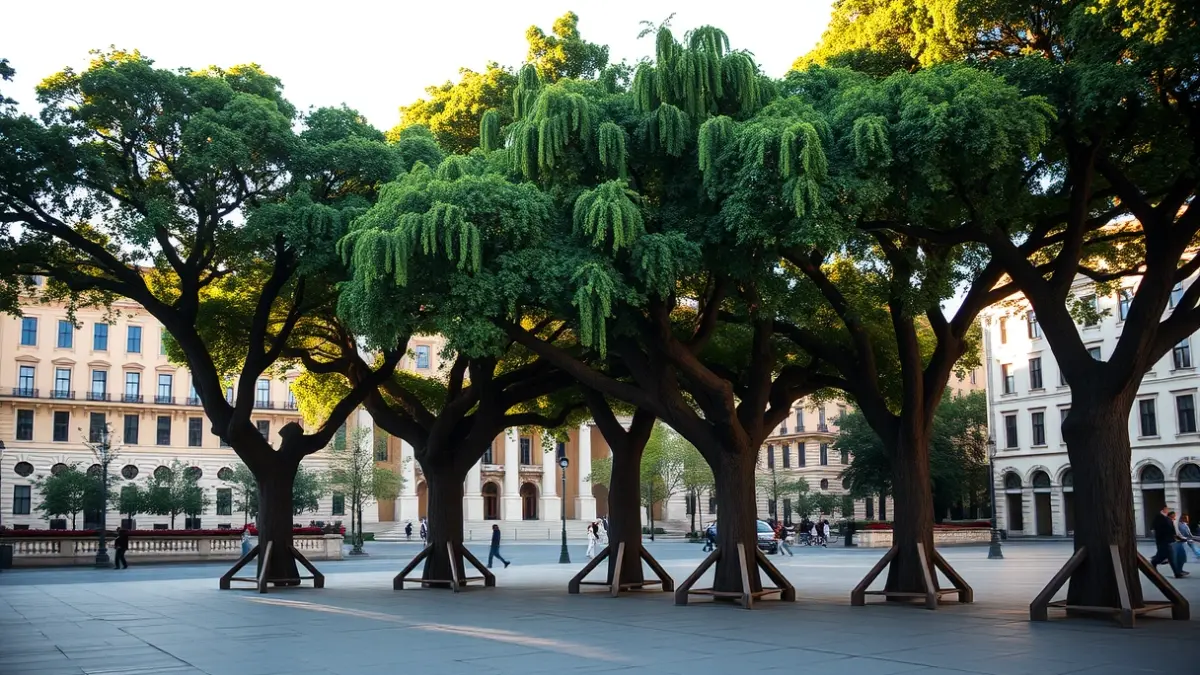
These eight plane trees, arranged in two rows between the Magic Fountain and the Mies van der Rohe Foundation, were replanted a few weeks ago. Their presence is notable due to their size and the wooden structures protecting them. These trees arrived in Montjuïc almost a century ago, as part of the urban development carried out for the 1929 International Exposition.
The transplant was moved forward in the construction schedule to ensure the survival of the specimens, as there is an optimal period for this delicate operation. Replanting a tree is a slow and stressful process, according to experts. The head of the Strategy Department of the Municipal Institute of Parks and Gardens has detailed the steps involved and the long wait to confirm the success of the operation, which is expected to coincide with the centenary of the International Exposition and the trees.
“"It would always be much more favorable for the volume of soil to be as large as possible, but if circumstances do not allow it, you have to compensate for both parts."
The policy of Parks and Gardens is to avoid moving trees from their original location whenever possible. However, in cases like this, it is necessary. The species Platanus acerifolia is suitable for transplanting, but this must be done during the dormant period, which runs from autumn (October-November) to late winter (until March). The operation involves reducing the volume of both the roots and the canopy to maintain balance, wrapping the roots with a coconut fiber mesh and a wire mesh for consistency.
Once planted, the trees require great stability, which is why support structures are installed. Movement could prevent the roots from settling correctly, risking the tree's survival. For the first few years, these plane trees will receive constant irrigation with groundwater, with an input of between 80 and 100 liters twice a week. Although they already show sprouts and green leaves, full adaptation may take two to four years, as the initial sprouts emerge from accumulated reserves.
Not all tree species are suitable for transplanting. While plane trees, holm oaks, and tipuanas have high probabilities of survival if transplanted at the right time, species such as cypresses, pines, or conifers have an almost zero success rate, which is why Parks and Gardens does not transplant them. Other recent examples include the relocation of unique holm oaks in Sants square and a historic laurel in Sant Andreu.