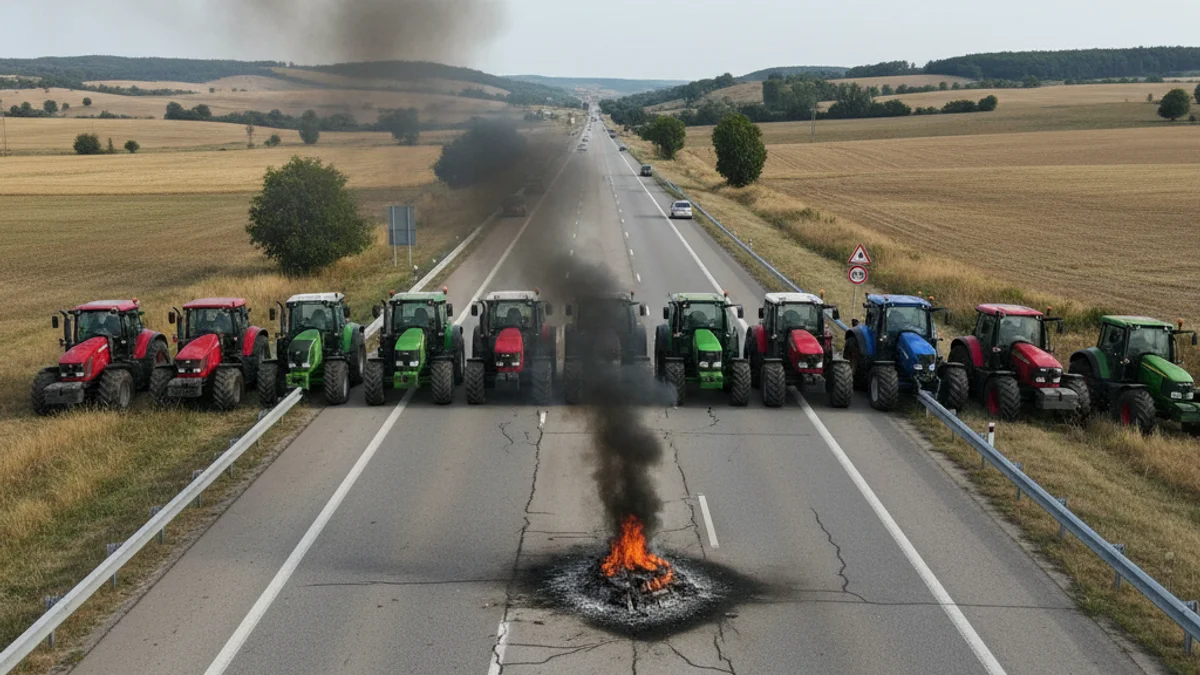
The traffic cuts, which were replicated across Catalonia and Europe, affected key points of the Catalan road network. In the Lleida region, blockades were located on the N-230 in el Pont de Suert, the N-260 in Sort, and the A-2 in Bell-lloc d'Urgell and Golmés. In Ponent, demonstrators agreed around 12:30 p.m. to cut the highway in both directions.
The protest, supported by the unions Asaja and Unió de Pagesos, argues that the agreement with Latin American countries (Argentina, Brazil, Paraguay, and Uruguay) will lead to a loss of competitiveness for the Catalan agricultural sector. Furthermore, farmers warn that food products from Mercosur do not undergo the same safety controls required in the European Union, jeopardizing food safety.
“"The agreement is bad for the farming community, but also for the citizens, as it compromises food safety."
Jordi Ginabreda, spokesperson for the Gremi de la Pagesia, described the agreement as having a “devastating effect” and regretted that governments use food as a bargaining chip. The sector demands the application of “mirror clauses,” which would force imported products to meet the same conditions required of local producers, especially regarding the use of pesticides or growth hormones prohibited in the EU.
The protest occurs during the final stages of negotiations in Brussels. This Friday is considered a key date to unblock the formal signing of the agreement, which the European Commission claims is a “strategic necessity.” The deal, which has been negotiated for over 25 years, was close to being finalized in December 2025 but was postponed due to doubts from Italy and the blocking position of France.