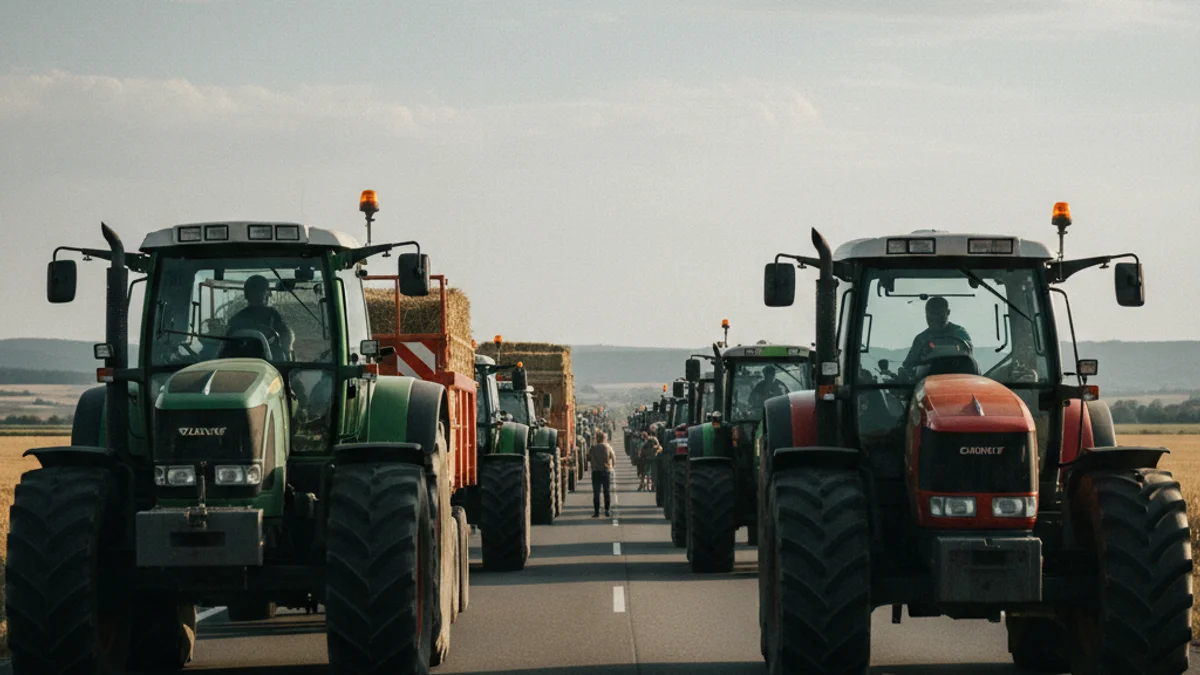
The mobilization, which gathered farmers from Osona, Bages, Anoia, and Berguedà, caused traffic complications on the C-16 heading towards Berga around one in the afternoon. This action is part of a broader day of protest by the Catalan agricultural sector.
The protests affected several strategic roads. In Alt Empordà, tractors cut off the AP-7 and the N-II, with closures between Borrassà and Vilademuls. Traffic jams were also recorded in the Girona area on the N-260 and N-II. In Tarragona, the closure was located on the T-11 and the A-27, while in Lleida, cuts occurred on the A-2 in Bell-Lloc d'Urgell and Golmés.
“"Food will arrive from Mercosur made with products that are illegal here. What kind of governments do we have, that use food and the primary sector as bargaining chips."
The organization's spokesperson, Jordi Ginabreda, warned that the agreement could have a “devastating” effect on the sector, as it risks food safety by allowing the entry of products treated with pesticides or growth hormones prohibited in the European Union. The sector demands the application of mirror clauses, requiring imported food to meet the same production standards as local produce.
The protest took place just before a key date in Brussels, where this Friday the formal signing of the agreement with the Mercosur countries (Argentina, Brazil, Paraguay, and Uruguay) could be unlocked. The European Commission defends the pact as a “strategic necessity,” despite the reluctance of member states like France and Italy.