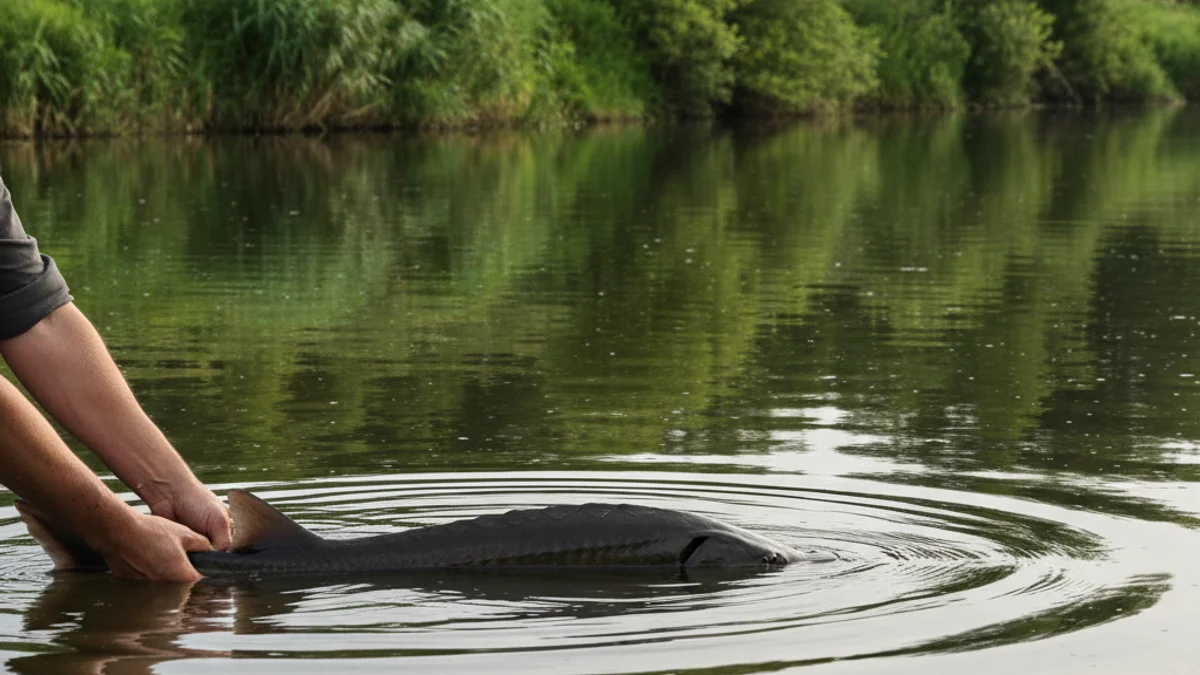
This marks the third sturgeon release carried out in the Ebro River, a species that had vanished from the area half a century ago. The 44 new specimens arrived from France and underwent a few days of adaptation at the IRTA aquaculture center in La Ràpita before being released in Tivenys (Baix Ebre).
The project, coordinated by Marx Ordeix of the CERM at the University of Vic, highlighted the “correct” behavior of the fish released since 2023. This behavior includes movements between the estuary and the sea, considered “ideal and expected” by scientists, similar to what has been observed in sturgeon reintroduction in rivers like the Garonne or the Dordogne.
“"When we released them, we saw them heading towards the final stretch of the river; some went to the sea, around the Delta, and others stayed in the estuary. This is an ideal and expected behavior."
The specimens originate from the captive breeding center of INRAE (National Institute for Research in Sciences and Technologies for the Environment and Agriculture) in Saint Seurin-sur-l'Isle, in the Nouvelle-Aquitaine region, thanks to an agreement with the French government. Although 50 specimens were released last year, this year the figure is 44. The 2026 release cannot take place due to the complexity of breeding, and the next release is scheduled for 2027, provided reproduction in France is successful.
Ordeix noted that sturgeon reintroduction is a very slow process. It will take nearly two decades for these fish, which reach sexual maturity between 13 and 18 years old, to migrate upriver to reproduce naturally. The project has also aided the recovery of other migratory species, such as the shad, thanks to the fish ramps created under the Life MigratoEbre project, which help overcome barriers like the weirs of Xerta and Tivenys.