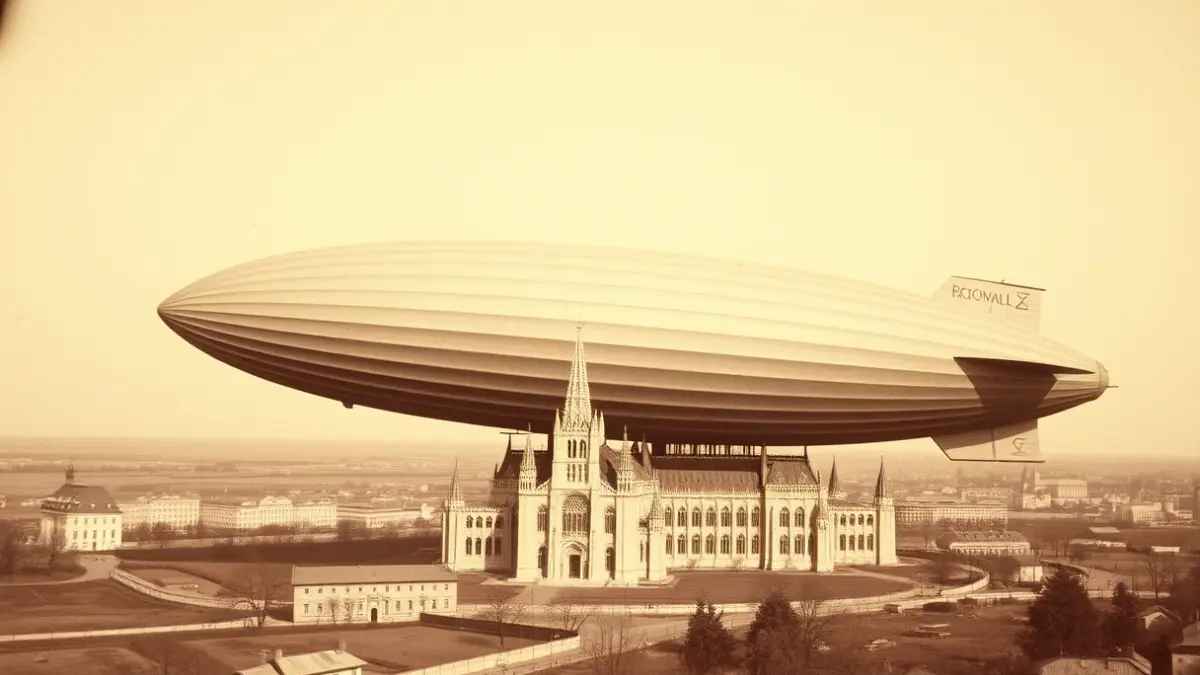
The year 1929 marked a turning point for Barcelona's international projection thanks to the International Exposition, which significantly transformed Montjuïc mountain. As part of the event's centenary, the City Council plans to renovate several palaces of the Fira de Barcelona. However, that same year also left an unusual image, immortalized by a photojournalist, showing the Graf Zeppelin airship passing over the Barcelona sky on May 16, just days before the exhibition's inauguration on May 20.
The snapshot, which has been recovered by a profile dedicated to colorizing old photographs, had previously circulated on social media. This image, signed by photojournalist Josep Badosa, who rented a small plane to capture the moment, reveals the airship flying over a Sagrada Familia still in its early construction phases and surrounded by fields. The appearance of Gaudí Avenue is also striking, practically without buildings up to the Hospital de Sant Pau, as this area of the Catalan capital was urbanized years later.
“"A Zeppelin flying over the Sagrada Familia, 1929."
The Graf Zeppelin entered Barcelona from the sea, flying over Ciutadella Park, what is now the Ciutat Vella neighborhood, Paral·lel Avenue, and Montjuïc mountain, the site of the exhibition. This aerial vehicle, named after its inventor, Ferdinand von Zeppelin, was the fastest airship in the world at the time, reaching speeds of 120 kilometers per hour, and the first enabled for commercial use, with capacity for about twenty passengers.
Under the command of Hugo Eckener and a crew of forty people, the aircraft made nearly 600 voyages between 1928 and 1937, flying over Barcelona on three occasions. In August 1929, the zeppelin made history by being the first airship to complete a circumnavigation of the world. Its trajectory ended in 1937, after the Hindenburg disaster, a fire that caused 35 deaths in New Jersey on May 6 of that year, leading to distrust in the viability of this type of transport.