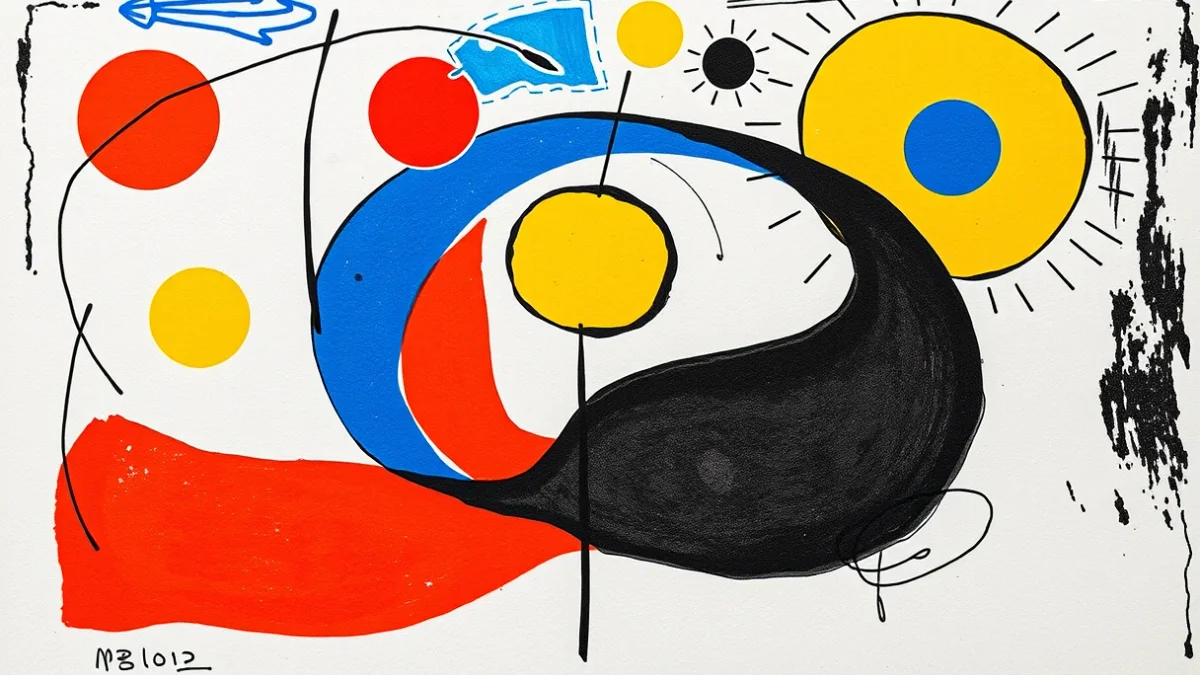
Joan Punyet Miró, representative of the Successió Miró, argues that his grandfather created a unique artistic language that did not continue beyond his own work. The reedition of Cántico del Sol, based on the poem Cántico de las criaturas by Saint Francis of Assisi, has been recovered by the publishing house Artika in a limited edition of 2,998 copies.
The project, which required seven years of research and over twenty visits to the Fundació Miró (which recently commemorated its 50th anniversary), aims to reproduce with maximum fidelity the original edition that Joan Miró created alongside editor Gustavo Gili and printer Joan Barbarà.
“"The biggest challenge has been achieving the Miró colors."
Beyond the technical aspect, the work stands out for the connection between Saint Francis of Assisi and Joan Miró, who, according to his grandson, shared a profound vision of the relationship between humans and nature. This choice of a medieval text, even though Miró illustrated contemporary poets, responds to a question of universality.
“"Christian faith is universal, as is the union with the Earth. That is why Miró jumps back seven centuries and connects with the sun, the moon, the water, and the wind."
Punyet considers the Cántico del Sol an authentic self-portrait, where the mystical and the telluric converge. Miró linked this duality to his experience in Mont-roig del Camp, where Mas Miró is located, and which is manifested in his “cosmic calligraphy.”
“"We will all disappear someday, but this book will remain alive. It will speak of Miró, his language, and a universal vision that was born and died with him."