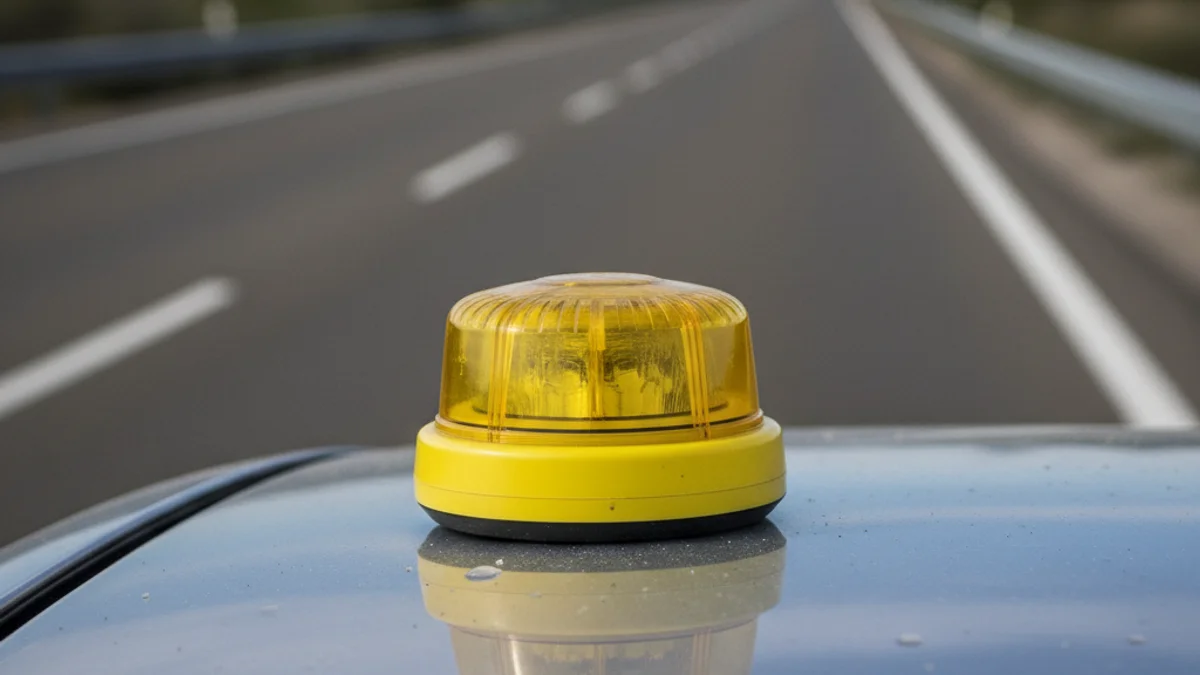
The Dirección General de Tráfico (DGT) argues that the device improves road safety by preventing drivers from leaving the vehicle and offering better visibility, in addition to sending a direct warning. However, many drivers in the Girona region have expressed skepticism, claiming the measure is driven more by commercial interests than genuine safety improvement.
“"I believe this is blatant robbery."
Some users, like Pere Navarro, have encountered practical problems with installation, as the beacon only attaches to metallic surfaces, excluding vehicles with glass roofs. Others, such as Anna Matamala, believe that on roads with poor visibility or curves, emergency triangles are more effective. Nevertheless, Matamala acknowledges the benefit of being able to signal a breakdown without having to exit the vehicle.
Another point of contention is data protection. The beacon sends the vehicle's location to the DGT 3.0 connected transport platform. Jurist Alejandro Rusiñol highlighted the lack of clarity regarding privacy. The director of the Servei Català de Trànsit, Ramon Lamiel, also admitted that there has been a lack of a proper communication campaign to specify approved models.
“"A person's location is very sensitive data. That is why European law requires that these types of systems be implemented with special care and after a prior data protection impact assessment."
The fine for not carrying the V16 is 80 euros, the same as for the triangles. Despite the mandatory nature, the Security Councilor of El Port de la Selva, Roger Pinart, has instructed the municipal police not to carry out specific checks, stating that their function is to «help the citizen and not to bother them».