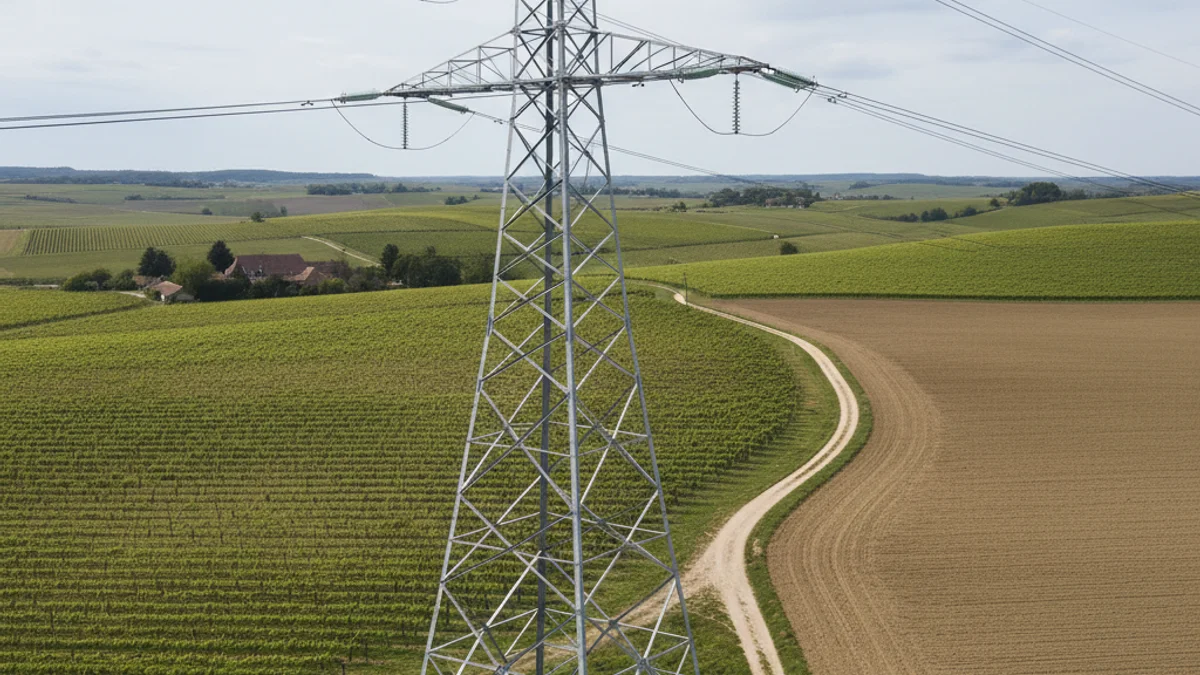
The new Very High Voltage (MAT) infrastructure will feature a double circuit (220 kV and 400 kV) spanning 180 kilometers, with towers rising up to 55 meters, significantly taller than the current 20-25 meter structures. This power increase will impact 28 municipalities in the counties of Terra Alta, Ribera d'Ebre, Priorat, Baix Camp, and Tarragonès.
Although the route will largely follow the existing line from the 1970s, which will be dismantled, some sections will be diverted, affecting new municipalities like Marçà (Priorat) and Alforja (Baix Camp). The project includes new substations, such as Els Aubals in García (Ribera d'Ebre) and El Francolí, near Vilallonga del Camp, which is intended to support the decarbonization of Tarragona's chemical industry.
“"It implies a much greater impact on the territory in terms of health, agriculture, and the environment."
The No to the MAT Aragon-Catalonia Platform, which includes residents and organizations, has expressed strong opposition, arguing that this is not a simple “renovation” but a new project that triples the power capacity. The DO Terra Alta also opposes the plan, stating that the line “increases an already excessive territorial burden” and threatens the continuity of winegrowing operations.
The project has highlighted the “ambivalence” of some local administrations. While the mayor of L'Aleixar (Baix Camp), Josep Biosca, criticizes the “oversizing” and the negative impact on cultural tourism, the mayor of La Selva del Camp, Enric Roberto, is “in favor” of electrification, although he is concerned about the visual impact.
Both projects were recently published in the Official State Gazette (BOE) and the Official Gazette of the Government of Catalonia (DOGC), opening a 30-working-day period for the submission of allegations. Several municipalities, coordinated by the Baix Camp County Council, and organizations like Unió de Pagesos, are preparing joint allegations.