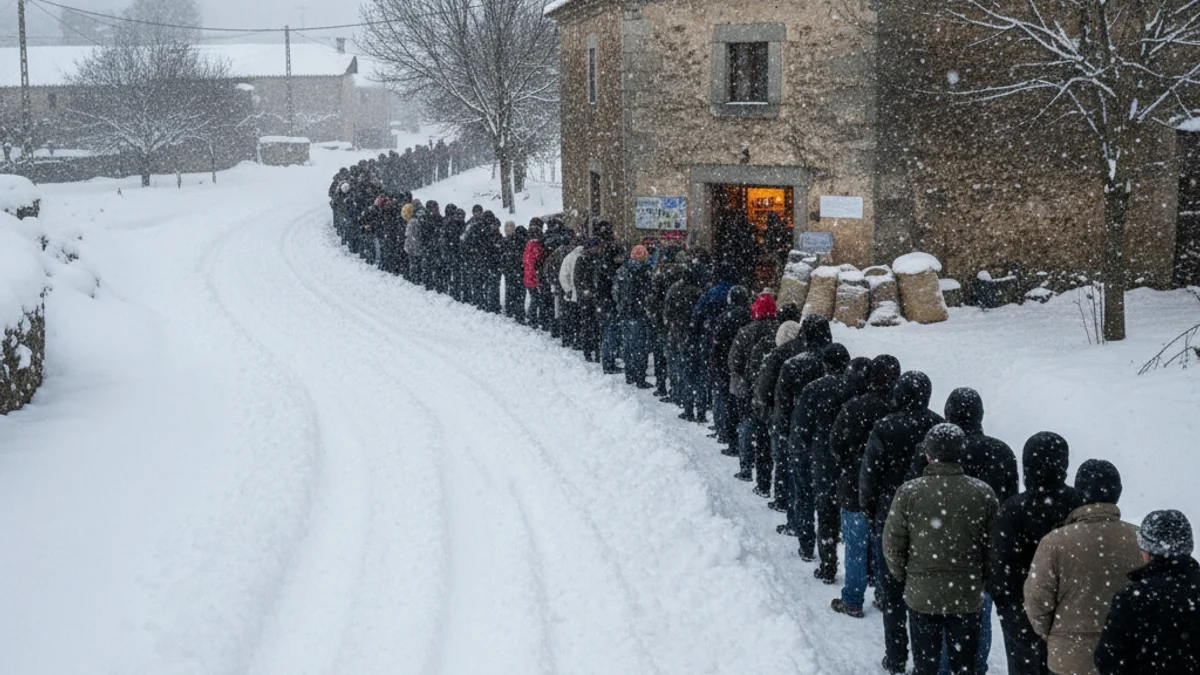
If one looks for the most impactful snowfall in inland Catalonia in recent decades, all attention turns to the storm of January 30, 1986. This event disrupted life in most counties, leaving numerous municipalities in Anoia, Bages, Berguedà, and Solsonès without power, causing serious problems for industries, businesses, and farms.
The main consequence was the severe disruption of the electricity supply. Failures in high, medium, and low-voltage lines, caused by falling trees and towers, left a large part of Central Catalonia without light. Electric companies warned that the complete normalization of the service would take up to three days in some areas. Furthermore, problems were reported in the drinking water supply due to the inability to operate pumping systems, and telephone service was interrupted in some towns.
Public transport was also severely affected. A Renfe train derailed near Calaf without causing injuries, but the incident, combined with trees falling onto the catenary, forced the suspension of rail traffic for hours. In Manresa and most urban centers in Bages, the combination of snow, sleet, and rain limited accumulation, allowing circulation to remain open, albeit with difficulties.
Meteorologically, the cause was a large Atlantic depression located in Iceland on January 29, 1986, which detached and moved towards the Catalan coast on the morning of the 30th. The depression drove a mass of humid air from the Mediterranean, mixing with very cold continental air. This combination generated precipitation nearing 100 mm and northeast winds exceeding 100 km/h. Snow depths of 60 centimeters were recorded in Moià, 20 in Solsona, 14 in Igualada, and 7 in Manresa, according to data from the Servei Meteorològic de Catalunya. The 1986 snowfall is considered one of the historical ones in Catalonia, along with those of 1962 and 2010.