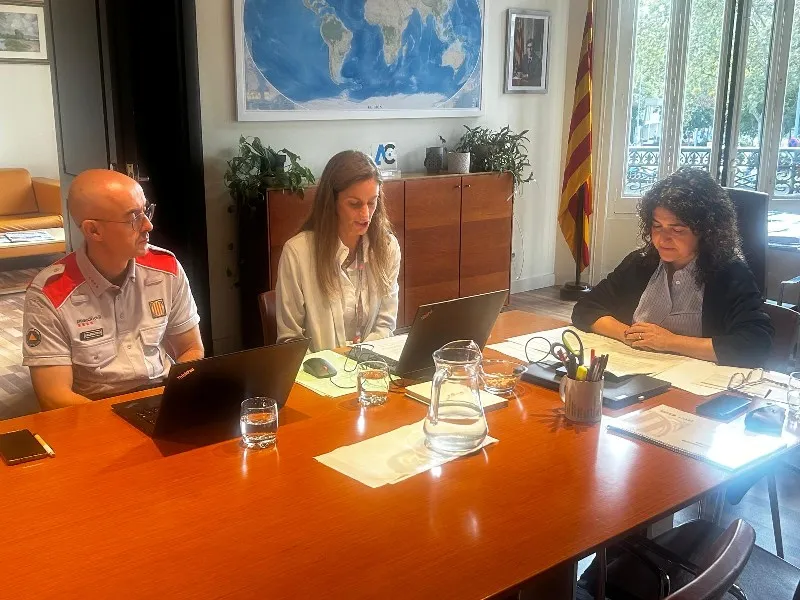
The Commissioner, appointed last July and reporting directly to Mayor Jaume Collboni, takes on the challenge of addressing the worrying situation of Catalan in Barcelona, where only 35% of citizens speak it habitually. Salicrú, who previously directed Ràdio Primavera Sound and was editor-in-chief of Time Out magazine, attributes the decline to a general “relaxation”.
“"There is a situation of relaxation on the part of institutions that do not sufficiently review compliance with regulations. There is also a citizenry that thinks that Catalan is something we already have and for which we do not have to fight."
The main axes of her action are to guarantee the linguistic rights of citizens who choose Catalan and to increase the number of speakers, focusing on two strategic groups: young people and people of international origin. For young people, the strategy involves promoting usage in digital channels, leisure, and sports, including the launch of the Casa de la Creació Digital en Català (House of Digital Creation in Catalan), a starting point for a solid creator ecosystem.
Regarding regulation, Salicrú emphasizes the need to incorporate linguistic regulations into municipal inspection protocols. Currently, inspection falls to the city councils and sanctions to the Agència Catalana de Consum (Catalan Consumer Agency) of the Generalitat. The commissioner is working to make the council's inspection work effective, acknowledging that previously, insufficient inspections were carried out in this area.
Concerning the restaurant sector, where 50% of workers do not speak Catalan, the campaign promoted by the Gremi de Restauració (Restaurant Guild) and ERC is seen as a good starting point, although not sufficient. Salicrú has sought to contribute, such as highlighting the Comerços Aprenents program of the Consorci per a la Normalització Lingüística, which offers on-site linguistic advice to establishments.
The commissioner's foundational goal is to create a structural Catalan area within the City Council, independent of mandates. She hopes that, with thorough work, a substantial change in language issues will be achieved in a period similar to what was accomplished in gender issues, stressing that the demand for places to study Catalan increases exponentially every year.